For your Friday reading pleasure, a 2001 Atlantic article (adapted from his “Fast Food Nation“) by Eric Schossler on Why McDonald’s Fries Taste So Good:
The taste of a french fry is largely determined by the cooking oil. For decades McDonald’s cooked its french fries in a mixture of about seven percent cottonseed oil and 93 percent beef tallow. The mixture gave the fries their unique flavor — and more saturated beef fat per ounce than a McDonald’s hamburger.
In 1990, amid a barrage of criticism over the amount of cholesterol in its fries, McDonald’s switched to pure vegetable oil. This presented the company with a challenge: how to make fries that subtly taste like beef without cooking them in beef tallow. A look at the ingredients in McDonald’s french fries suggests how the problem was solved. Toward the end of the list is a seemingly innocuous yet oddly mysterious phrase: “natural flavor.” That ingredient helps to explain not only why the fries taste so good but also why most fast food — indeed, most of the food Americans eat today — tastes the way it does.
Malcolm Gladwell of the New Yorker apparently wrote about the same subject area in 2001, concentrating more on McDonald’s attempts to make healthier versions of its food (remember the McLean? (sub-parenthetical thought: there’s far fewer Googlable articles about the McLean than I thought there would be, given its notoriety))
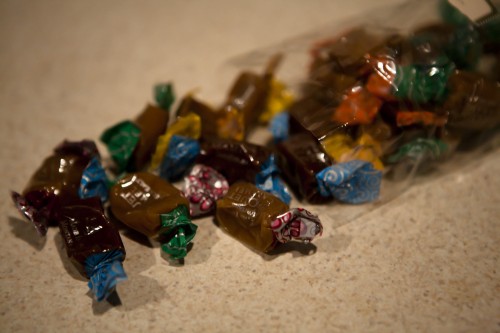
My favorite part of Schossler’s article is his exploration of the flavor chemical industry, by which one drop of something like methyl-2-pyridyl ketone can make a jelly-bean taste like popcorn.
Some excerpts:
A nose can detect aromas present in quantities of a few parts per trillion — an amount equivalent to about 0.000000000003 percent…The quality that people seek most of all in a food — flavor — is usually present in a quantity too infinitesimal to be measured in traditional culinary terms such as ounces or teaspoons. The chemical that provides the dominant flavor of bell pepper can be tasted in amounts as low as 0.02 parts per billion; one drop is sufficient to add flavor to five average-size swimming pools. The flavor additive usually comes next to last in a processed food’s list of ingredients and often costs less than its packaging. Soft drinks contain a larger proportion of flavor additives than most products. The flavor in a twelve-ounce can of Coke costs about half a cent.
How to make something taste like a strawberry:
A typical artificial strawberry flavor, like the kind found in a Burger King strawberry milk shake, contains the following ingredients: amyl acetate, amyl butyrate, amyl valerate, anethol, anisyl formate, benzyl acetate, benzyl isobutyrate, butyric acid, cinnamyl isobutyrate, cinnamyl valerate, cognac essential oil, diacetyl, dipropyl ketone, ethyl acetate, ethyl amyl ketone, ethyl butyrate, ethyl cinnamate, ethyl heptanoate, ethyl heptylate, ethyl lactate, ethyl methylphenylglycidate, ethyl nitrate, ethyl propionate, ethyl valerate, heliotropin, hydroxyphenyl-2-butanone (10 percent solution in alcohol), a-ionone, isobutyl anthranilate, isobutyl butyrate, lemon essential oil, maltol, 4-methylacetophenone, methyl anthranilate, methyl benzoate, methyl cinnamate, methyl heptine carbonate, methyl naphthyl ketone, methyl salicylate, mint essential oil, neroli essential oil, nerolin, neryl isobutyrate, orris butter, phenethyl alcohol, rose, rum ether, g-undecalactone, vanillin, and solvent.
The difference between natural and artificial flavors:
A natural flavor is not necessarily more healthful or purer than an artificial one. When almond flavor — benzaldehyde — is derived from natural sources, such as peach and apricot pits, it contains traces of hydrogen cyanide, a deadly poison. Benzaldehyde derived by mixing oil of clove and amyl acetate does not contain any cyanide. Nevertheless, it is legally considered an artificial flavor and sells at a much lower price. Natural and artificial flavors are now manufactured at the same chemical plants, places that few people would associate with Mother Nature.
Also, there’s a bit about how food-coloring is about as important as flavor to how humans perceive taste:
Food coloring serves many of the same decorative purposes as lipstick, eye shadow, mascara — and is often made from the same pigments. Titanium dioxide, for example, has proved to be an especially versatile mineral. It gives many processed candies, frostings, and icings their bright white color; it is a common ingredient in women’s cosmetics; and it is the pigment used in many white oil paints and house paints. At Burger King, Wendy’s, and McDonald’s coloring agents have been added to many of the soft drinks, salad dressings, cookies, condiments, chicken dishes, and sandwich buns…
Flavor researchers sometimes use colored lights to modify the influence of visual cues during taste tests. During one experiment in the early 1970s people were served an oddly tinted meal of steak and french fries that appeared normal beneath colored lights. Everyone thought the meal tasted fine until the lighting was changed. Once it became apparent that the steak was actually blue and the fries were green, some people became ill.
Mmmm…burgers….
Grainger had brought a dozen small glass bottles from the lab. After he opened each bottle, I dipped a fragrance-testing filter into it — a long white strip of paper designed to absorb aroma chemicals without producing off notes. Before placing each strip of paper in front of my nose, I closed my eyes. Then I inhaled deeply, and one food after another was conjured from the glass bottles. I smelled fresh cherries, black olives, sautéed onions, and shrimp. Grainger’s most remarkable creation took me by surprise. After closing my eyes, I suddenly smelled a grilled hamburger. The aroma was uncanny, almost miraculous — as if someone in the room were flipping burgers on a hot grill. But when I opened my eyes, I saw just a narrow strip of white paper and a flavorist with a grin.
Speaking of flavor, one of the more interesting angles I got out of the New York Times recent investigation into the food industry’s efforts to combat salt limits is how integral that compound is to making many foods taste good, from cookies to coffee. The industry argues that with less salt, they’d need better ingredients to keep a food’s flavor. Good reading if you have even more time to read about food today:
Even as it was moving from one line of defense to another, the processed food industry’s own dependence on salt deepened, interviews with company scientists show. Beyond its own taste, salt also masks bitter flavors and counters a side effect of processed food production called “warmed-over flavor,†which, the scientists said, can make meat taste like “cardboard†or “damp dog hair.â€
…As a demonstration, Kellogg prepared some of its biggest sellers with most of the salt removed. The Cheez-It fell apart in surprising ways. The golden yellow hue faded. The crackers became sticky when chewed, and the mash packed onto the teeth. The taste was not merely bland but medicinal.
“I really get the bitter on that,†the company’s spokeswoman, J. Adaire Putnam, said with a wince as she watched Mr. Kepplinger struggle to swallow.
They moved on to Corn Flakes. Without salt the cereal tasted metallic. The Eggo waffles evoked stale straw. The butter flavor in the Keebler Light Buttery Crackers, which have no actual butter, simply disappeared.
Bon Appetit!
Hat-tip to Longform.org; if you haven’t bookmarked this Instapaper-friendly site, do it. It’s made my gratuitous purchase of an iPad almost worth it.





 This paean to developers from Tom Taylor, of London-based design firm Really Interesting Group, is too stupid and full of self-important bullshit to ask you to read it in its entirety, so I’ll sum up the excerpts: