MOMA and van Gogh on Google Art Project

Vincent Van Gogh's Starry Night

But it’s not just an art-browser…it has the kind of zoom and pan functions found on Google Maps. You can see the artwork so close up you can practically feel the MOMA guards tackling you to the ground.
http://www.googleartproject.com/museums/moma/the-starry-night
Is Solitary Confinement Torture? From Atul Gawande and the New Yorker
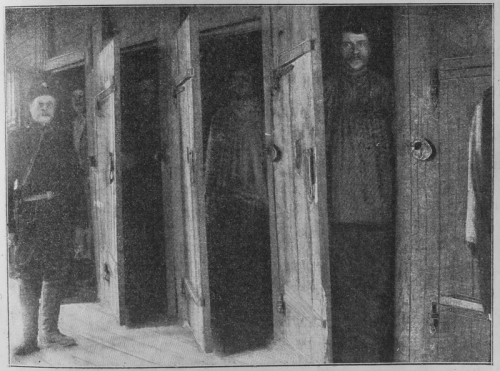
Punishment Cells. From: Page 257 of part II of Vlas Mikhailovich Doroshevich «Sakhalin (Katorga)», Moscow. Sytin publisher, 1905.
Thanks to longform.org for spotlighting another thought-provoking piece by Dr. Atul Gawande in the New Yorker. The tag line is: Hellhole: The United States holds tens of thousands of inmates in long-term solitary confinement. Is this torture?
Dr. Gawande’s reporting builds a strong case for “Yes.” Some interesting bullet points:
- America holds at least 25,000 inmates in solitary confinement in Supermax prisons
- More than a century ago, the U.S. Supreme Court considered banning solitary confinement
- A 2003 analysis of Arizona, Illinois, and Minnesota found that levels of inmate-on-inmate violence were unchanged after their supermax prisons opened
- The state of Maine has more inmates in long-term solitary than does all of England
Supermax prisons and the long-term isolation of large numbers of inmates, Dr. Gawande notes, is only a decades-old concept in the American prison system. However, in the 1890 SCOTUS case, Medley vs. U.S., the court takes note of a solitary confinement system in Philadelphia back in 1787. The conditions and consequences, noted more than two centuries ago, aren’t much different than what Dr. Gawande describes today:
The peculiarities of this system were the complete isolation of the prisoner from all human society, and his confinement in a cell of considerable size, so arranged that he had no direct intercourse with or sight of any human being and no employment or instruction….
A considerable number of the prisoners fell, after even a short confinement, into a semi-fatuous condition, from which it was next to impossible to arouse them, and others became violently insane; others still committed suicide, while those who stood the ordeal better were not generally reformed, and in most cases did not recover sufficient mental activity to be of any subsequent service to the community.
It became evident that some changes must be made in the system, and the separate system was originated by the Philadelphia Society for Ameliorating the Miseries of Public Prisons, founded in 1787.
Following the standard journalistic narrative, Dr. Gawande leads with his best anecdote and ends with his second-best. The entire piece is a must read, but the last anecdote is particularly astonishing. Gawande describes the case of Robert Felton, who spent 14 years of his 36 years on earth in solitary confinement. The isolation drove him crazy, Gawande writes, and Felton tried so many times to set his cell on fire with a lightbulb that “the walls of his cell were black with soot.”
Gawande writes about one of his last meetings with Felton. Felton had just found out the prison director who kept him in solitary confinement had just been convicted of bribery (from lobbyists, a sidestory that would probably illuminate why America holds on to certain prison strategies regardless of effect) and sentenced to two years in prison:
“Two years in prison,†Felton marvelled. “He could end up right where I used to be.â€
I asked him, “If he wrote to you, asking if you would release him from solitary, what would you do?â€
Felton didn’t hesitate for a second. “If he wrote to me to let him out, I’d let him out,†he said.
This surprised me. I expected anger, vindictiveness, a desire for retribution. “You’d let him out?†I said.
“I’d let him out,†he said, and he put his fork down to make the point. “I wouldn’t wish solitary confinement on anybody. Not even him.â€
New York City Blizzard, January 26, 2011
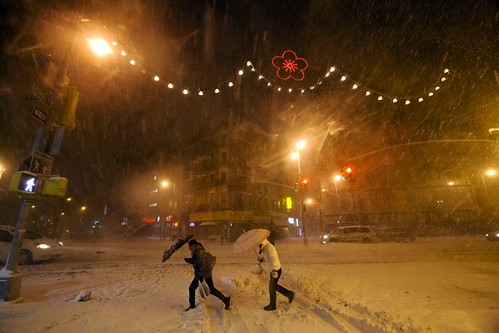
Umbrellas forward in Chinatown New York Blizzard, January 26, 2011, originally uploaded by Dan Nguyen @ New York City.
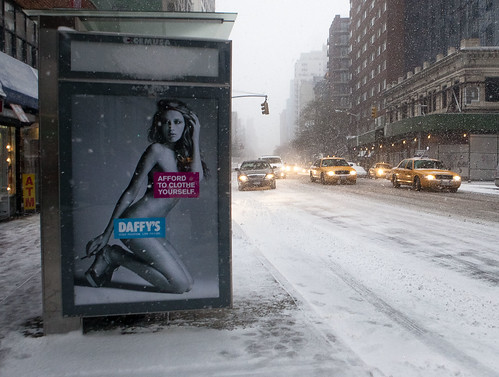
Another great snowstorm for New York, this one was definitely more substantial than the last one. I went out to Chinatown, NoHo, and Nolita to see the flakes come down and was lucky I didn’t lose a finger to frostbite. You can see all my Winter 2010-2011 photos in my Flickr set.
New York Blizzard 2011, Snowstorm Part Deux

I know it’s more than inconvenient for many people, but I kind of like another chance to go sledding this year. See all my 2010/2011 New York winter photos in my Flickr Set.
“We are detectives for the people” – Village Voice’s Wayne Barrett’s Final Column
 Legendary reporter Wayne Barrett filed his last column for the Village Voice this week. It reads like it’s from someone who has muckraked for nearly 40 years and has had a lot of time to think about his job:
When I was asked in recent years to blog frequently, I wouldn’t do it unless I had something new to tell a reader, not just a clever regurgitation of someone else’s reporting.
My credo has always been that the only reason readers come back to you again and again over decades is because of what you unearth for them, and that the joy of our profession is discovery, not dissertation.
There is also no other job where you get paid to tell the truth. Other professionals do sometimes tell the truth, but it’s ancillary to what they do, not the purpose of their job. I was asked years ago to address the elementary school that my son attended and tell them what a reporter did and I went to the auditorium in a trenchcoat with the collar up and a notebook in a my pocket, baring it to announce that “we are detectives for the people.”
…It never mattered to me what the party or ideology was of the subject of an investigative piece; the reporting was as nonpartisan as the wrongdoing itself. I never looked past the wrist of any hand in the public till. It was the grabbing that bothered me, and there was no Democratic or Republican way to pick up the loot.
Ten Favorite Photos of 2010

Some favorites
2010 wasn’t a very productive year for me in terms of photography. I can think of two factors: this investigative project taking up most of my time the latter part of the year, and getting a Canon S90 (well, two of them, since I lost one). Not that the S90 isn’t great; a few snapshots from it are on this list. But it made photography a lot more casual for me, rather than something I worked at.
So as a result, there’s not a lot of variety here and everything seems somewhat distant and impersonal. I don’t know if these are my top sentimental or technical favorites, but they’re the ones that stood out after a quick look-through of my Flickr this morning.
Snowloko: Getting Around in New York’s Blizzard
Subway, car, and foot…the snow drifts conquered it all. I’ve seen snow fall into a subway platform before, but not huge drifts (this photo doesn’t do it justice, but it’s the only one I have that actually caught the train in focus).

The R train arrives at a snowed in 8th Street Station – New York Blizzard Snowstorm Blargfest, originally uploaded by Dan Nguyen NY.
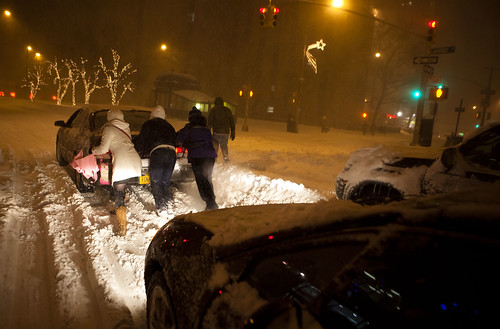
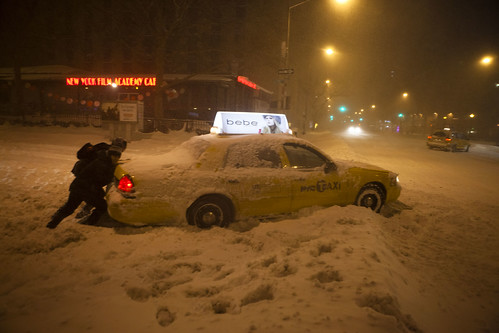
I love that mass-transit-dependent New Yorkers won’t hesitate to help push a car out of the snow. It’s so strange to walk through the otherwise traffic-clogged streets that pushing a car through Astor Place is actually a treat.
I wish I had booties, like my friend’s dog:

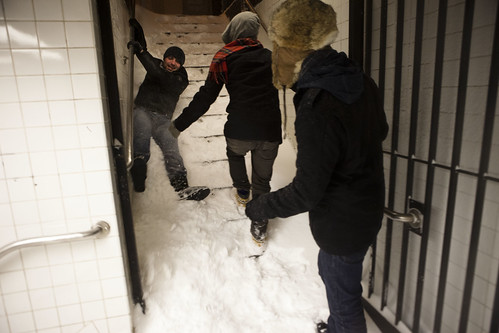
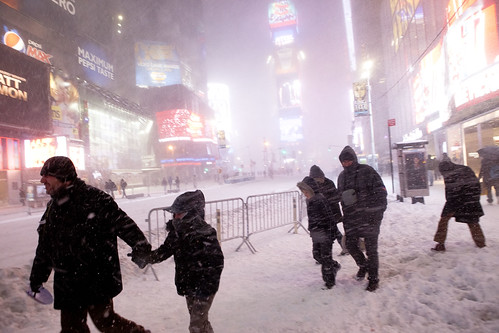
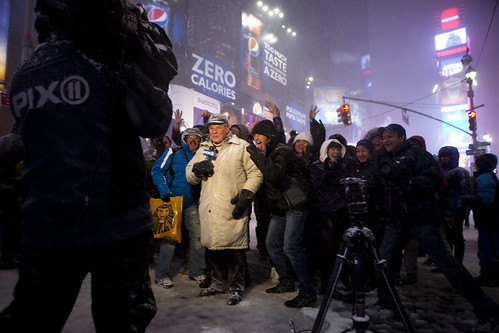
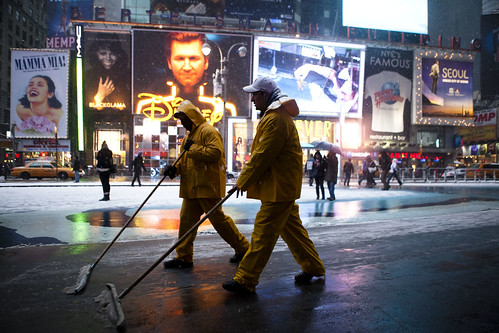
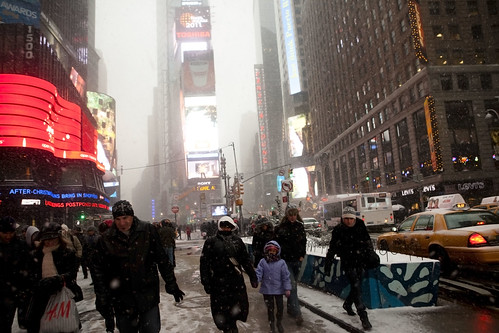
Snowball fight in Times Square, Snowpocalpyse-Thundersnow 2010
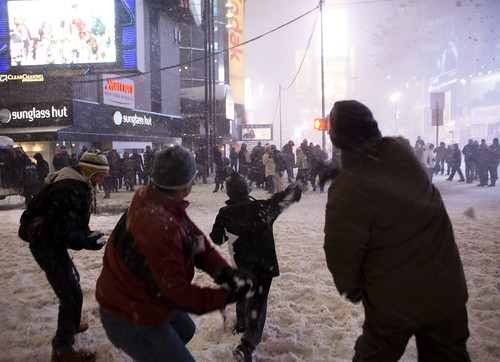
Snowball fight in Times Square – New York Blizzard Snowstorm Blargfest, originally uploaded by Dan Nguyen NY.
During last night’s blizzard, there was an attempt at a mass snowball fight like last year’s. People spent more time pelting vehicles than each other, since they had to fight across a street, and It petered out after a few minutes.
I think the main difference between this year and last was that last year, the TKTS plaza area was open, providing a much bigger common space to goof around in. That area has been closed to prepare for New Year Eve’s festivities.
Also, the weather was much blustier this year…there was lightning and thunder, not that you could really notice the former in Times Square. See my pics of last year’s snowball fight here.
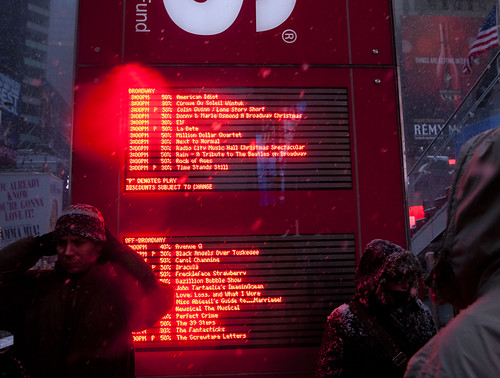
The Father Duffy Square, where the TKTS stand is, was closed off:
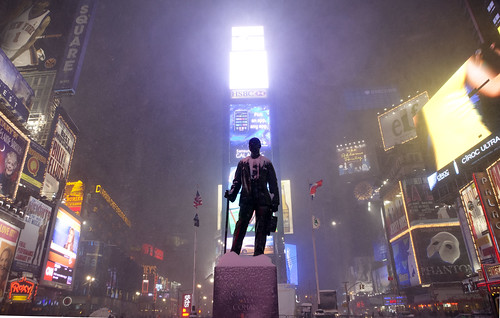
Last year was more of a big snow flurry. Last night was definitely a blizzard.