Author Archives: Dan Nguyen

Need a Flash gallery solution for your own hosted photos? Try DepGal 0.1

Yep, another flash photo gallery, but one that is focused on being fast, easy to update, and relatively-free of clutter that distracts from the photos.

I created DepGal for my own portfolio but figure everyone else might find some use for it. At some point, I’ll open-source it, after I clean up the code and get more feedback from the community.

DepGal’s homepage is here.

Roger Ebert: The joy of making out, and how we got here

Roger Ebert, my favorite movie-and-everything-else critic, gives some historical perspective on America’s road to sexual freedom and enjoyment. He spotlights a letter to the Daily Illini, written by an assistant professor of biology, that sparked off a national furor in 1960, but has since been forgotten, even by Wikipedia.

The letter:

With modern contraceptives and medical advice readily available at the nearest drugstore, or at least a family physician, there is no valid reason why sexual intercourse should not be condoned among those sufficiently mature to engage in it without social consequences and without violating their own codes of morality and ethics. A mutually satisfactory sexual experience would eliminate the need for many hours of frustrating petting and lead to happier and longer lasting marriages among our young men and women.

Google publicly calls out China over hacking of human rights advocates’ accounts

On the Google Blog, Google’s chief legal counsel David Drummond reveals that a “highly sophisticated and targeted” attack on its corporate infrastructure was traced back to China. The objective, Google believes, was to compromise the GMail accounts of Chinese human-rights activists (two were accessed, Google believes, with no actual content revealed).

This attack has apparently put a bug in Google’s conscience; Drummond writes that they are no longer willing to self-censor Google.cn:

These attacks and the surveillance they have uncovered–combined with the attempts over the past year to further limit free speech on the web–have led us to conclude that we should review the feasibility of our business operations in China. We have decided we are no longer willing to continue censoring our results on Google.cn, and so over the next few weeks we will be discussing with the Chinese government the basis on which we could operate an unfiltered search engine within the law, if at all. We recognize that this may well mean having to shut down Google.cn, and potentially our offices in China.

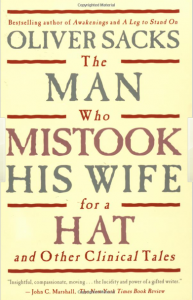
Lumps of clay for hands: Dr. Oliver Sacks’ “The Man Who Mistook His Wife for a Hat”

Last week, I bought a paperback version of Dr. Oliver Sacks’ “The Man Who Mistook His Wife for a Hat” just because I liked the title, and it’s been the best purchase I’ve made in months and the first book I’ve read through in about a year. It’s a collection of clinical tales of abnormal neurology and psychology. The titular essay is about a man who had perfectly fine eyesight and taught music at a prestigious school, but had a massive defect in internal visualization, hence, seeing a hat (and trying to pick it up) where his wife’s head was.

In many ways, it’s a depressing glimpse to at how our personalities, mannerisms, even our “souls” are so dependent on the material of the brain. In one chapter, a man murders his daughter under the influence of PCP and is blissfully unaware of the tragedy, until a massive head injury blissfully causes him to relive the memory as his own personal hell. On the whole, some of the anecdotes are inspiring, illustrating how what is perceived as abnormality by our society can be the basis for artistic genius. In one chapter, he describes a man with Tourette’s Syndrome who, despite constant outbursts of profanity, is able to live not only a relatively normal life, but also one in which is music and athletic skills are enhanced by the spastic neurons in his brain. When Dr. Sacks gives him a drug to mitigate his Tourette’s, the man finds he’s clumsier, less inspired…and gives up the drug rather than live a dull “normal” life (he ends up compromising by taking the drug during the workday, and letting his “normal” self shine on the weekends).

The following story probably has been made into a Lifetime movie, but is pretty inspiring no matter how normal your neurological condition may be:

Madeline J. was admitted to St. Benedict’s Hospital near New York City in 1980, her sixtieth year, a congenitally blind woman with cerebral palsy, who had been looked after by her family at home throughout her life. Given this history…I expected to find her both retarded and regressed.

She was neither. Quite the contrary: she spoke freely, indeed eloquently, revealing herself to be a high-spirited woman of exceptional intelligence and literacy.

“You’ve read a tremendous amount,” I said. “You must be really at home with Braille.”

“No, I’m not,” she said. “All my reading has been done for me – by talking-books or other people. I can’t read Braille, not a single word. I can’t do anything with my hands – they are completely useless.”

She held them up, derisively. “Useless godforsaken lumps of dough – they don’t even feel part of me.

I found this very startling. The hands are not usually affected by cerebral palsy…Miss J’s hands…her sensory capacities – as I now rapidly determined – were completely intact.

There was no impairment of elementary sensation, as such, but, in dramatic fashion, there was the profoundest impairment of perception. She could not identify – and she did not explore; there were no active ‘interogatory’ movements of her hands – they were, indeed, as inactive, as inert, as useless as “lumps of dough.”

Dr. Sacks then wonders if that Miss J’s hands are functionless because, being blind and tended to her whole life, she had never used them:

Had being ‘protected’, ‘looked after’, ‘babied’ since birth prevented her from the normal exploratory use of the hands which all infants learn in the first month of life? And if this was the case – it seemed far-fetched, but was the only hypothesis I could htink of – could she now, in her sixtieth year, acquire what she should have acquired in the first weeks and months of life?

Dr. Sacks devises a simple test of his hypothesis, to prod Miss J to use her hands out of necessity:

I thought of the infant as it reached for the breast. “Leave Madeleine her food, as if by accident, slightly out of reach on occasion,” I suggested to her nurses. “Don’t starve her, don’t tease her, but show less than your usual alacrity in feeding her.”

And one day it happened – what had never happened before: impatient, hungry, instead of waiting passively and patiently, she reached out an arm, groped, found a bagel, and took it to her mouth. This was the first use of her hands, her first manual act, in sixty years, and it marked her birth as a ‘motor individual’.

And then – this was within a month of her first recognitions – her attention, her appreciation, moved from objects to people…She started to model heads and figures, and within a year was locally famous as the Blind Sculptress of St. Benedict’s.

For me, for her, for all of us, this was a deeply moving, an amazing, almost a miraculous experience. Who would have dreamed that basic powers of perception, normally acquired in the first months of life, but failing to be acquired at this time, could be acquired in one’s sixtieth year? What wonderful possibilities of late learning, and learning for the handicapped, this opened up.

The rest of the chapter is as moving as this excerpt. It’s an old book, almost a classic as its first print was in 1970. If you’re like me and always far behind on your reading list, The Man Who Mistook His Wife for a Hat is worth picking up for its timeless scientific insight and wonder.

Quote of the Day from Ellen DeGeneres

I gotta work out. I keep saying it all the time. I keep saying I gotta start working out. It’s been about two months since I’ve worked out. And I just don’t have the time. Which uh..is odd. Because I have the time to go out to dinner. And uh..and watch tv. And get a bone density test. And uh.. try to figure out what my phone number spells in words.

Ellen DeGeneres

Haisong Jiang’s love saved us all


It just doesn’t feel right, considering the expense and inconvenience he caused, to not somehow punish Haisong Jiang for breaching Newark airport’s security for a last kiss. But this New York Post commenter makes a good case for amnesty:

HoboBobo
01/10/2010 10:19 PM
We should be thanking him. How else would we know how bad security was at Newark Airport without someone’s life actually being in danger. They TSA didn’t even have a recording video camera for crying out loud! They lucked out that the Continental camera caught the image.

It was an idiot act, but who knows how many lives Jiang saved by embarrassing the incompetents responsible for our safety.

Chartjunk? Slate’s Kaus vs. NYT’s David Leonhardt on hospital beds and better health care


An example of chartjunk: several colors and 26,000+ pixels to describe five hard-to-read numbers

David Leonhardt put forth a gee-that’s-unexpected-but-possible thesis in the Dec. 30 New York Times: Limiting hospital beds forces hospitals to provide more efficient care; allowing limitless beds pressures hospitals to fill them with patients undergoing unnecessary, costly treatments (Economic Scene: Health Cuts With Little Effect on Care):

Since 1996, the Richmond area has lost more than 600 of its hospital beds, mostly because of state regulations on capacity. Several hospitals have closed, and others have shrunk. In 1996, the region had 4.8 hospital beds for every 1,000 residents. Today, it has about three. Hospital care has been, in a word, rationed.

The quality of care in Richmond is better than in most American metropolitan areas, according to various measures, and it continues to improve. Medicare data, for example, shows that Richmond hospitals do a better-than-average job of treating heart attacks, heart failure and pneumonia.

…when it comes to health care costs, Richmond’s rationing has made a clear difference. In 1992, it spent somewhat less than average, per capita, on Medicare — 126th lowest out of 305 metropolitan areas nationwide. Since then, though, costs have risen at a significantly slower pace than they have elsewhere. As a result, Richmond had the 39th lowest costs in 2006.

A pretty tantalizing concept, and one that helps advocate for the school of thought that doctors should have some sort of restriction on how much “Cadillac” health care they can provide a patient. But even if Leonhardt’s thesis is correct, Slate’s Mickey Kaus is correct to point out that Leonhardt provides virtually no useful evidence to prove it:

1. In Richmond the number of beds per 1000 residents fell from 4.8 in 1996 to “about three.” You would now expect Leonhardt to unleash a string of stats showing that medical care in Richmond has gotten better despite these limits. You would be wrong. Care in Richmond is “better than in most American metroplitan areas,” says Leonhardt. OK, but what was it like before? Maybe it was better than nearly every metro area before. Richmond hospitals do a “better-than-average job of treating heart attacks,” Leonhardt says. OK, but were they much-better-than-average before? Anyway, that’s just heart attacks. … Oh, and a patient named Janet Binns–actually, a patient’s daughter–feels there is “nothing cheap about the care.” Well, all right then!

This goes on, for six more points, with Kaus accusing Leonhardt of being spoon-fed statistics from the White House’s own partisans.

Kaus himself doesn’t provide enough beef to make the accusation a clear verdict, but he’s right that Leonhardt’s statistical reasoning is shallow. He commits the most basic fallacy of “correlation does not imply causation” (What other reforms, demographic changes would’ve affected hospital Medicare data?). He just plain omits, Kaus points out, any substantial data (what are the “various measures” in which Richmond performs well in? In the on-the-other-hand statement, “Some of its hospitals do poorly on Medicare’s metrics,” what are these metrics, and how statistically significant are they compared to the ones Leonhardt uses to support his thesis?). And there are assumptions that seem like common sense…but on second thought…need more explanation (why is Richmond’s performance on heart attacks, heart failure and pneumonia the quality-care metric only worth mentioning?)

This thin-on-numbers piece is a bit unexpected considering that Leonhardt, according to his bio, studied applied mathematics at Yale. But maybe it’s not a failure of the reporting as it is the storytelling form. Leonhardt may have all the numbers, but lacks the column inches to describe them all.

So I’d consider it a textbook example of how traditional narrative can fall flat. Leonhardt’s claim just begs to be illustrated with a few charts and graphs. A line chart showing Richmond’s heart-attack-treatment metric from 1992 to 2006 would concisely refute Kaus’s point (at least one aspect of it) in far lesser space than 80 words. As it is, Leonhardt’s article is effectively a textual example of what infographic-guru Tufte calls “chartjunk”: an unnecessary amount of ink to, at best, clumsily support an important theory, or, at worst, to hide the skimpiness of the actual data.

The Times still leads the way in alternative forms of storytelling. You’ve probably already seen their amazing infographic plotting Netflix rentals by geography. 3,000 words (some of which would be devoted to pithy, but generally unhelpful, cherry-picked quotes from your average-Joe-Netflix-user, to illustrate why ‘Milk’ was so popular in Chelsea) would barely have covered the trends a single metro area, nevermind a dozen.

Spotted in the East Village: Hipster/Anti-Hipster/Anti-Anti-Hipster Spoof of Ghost Bike Memorial

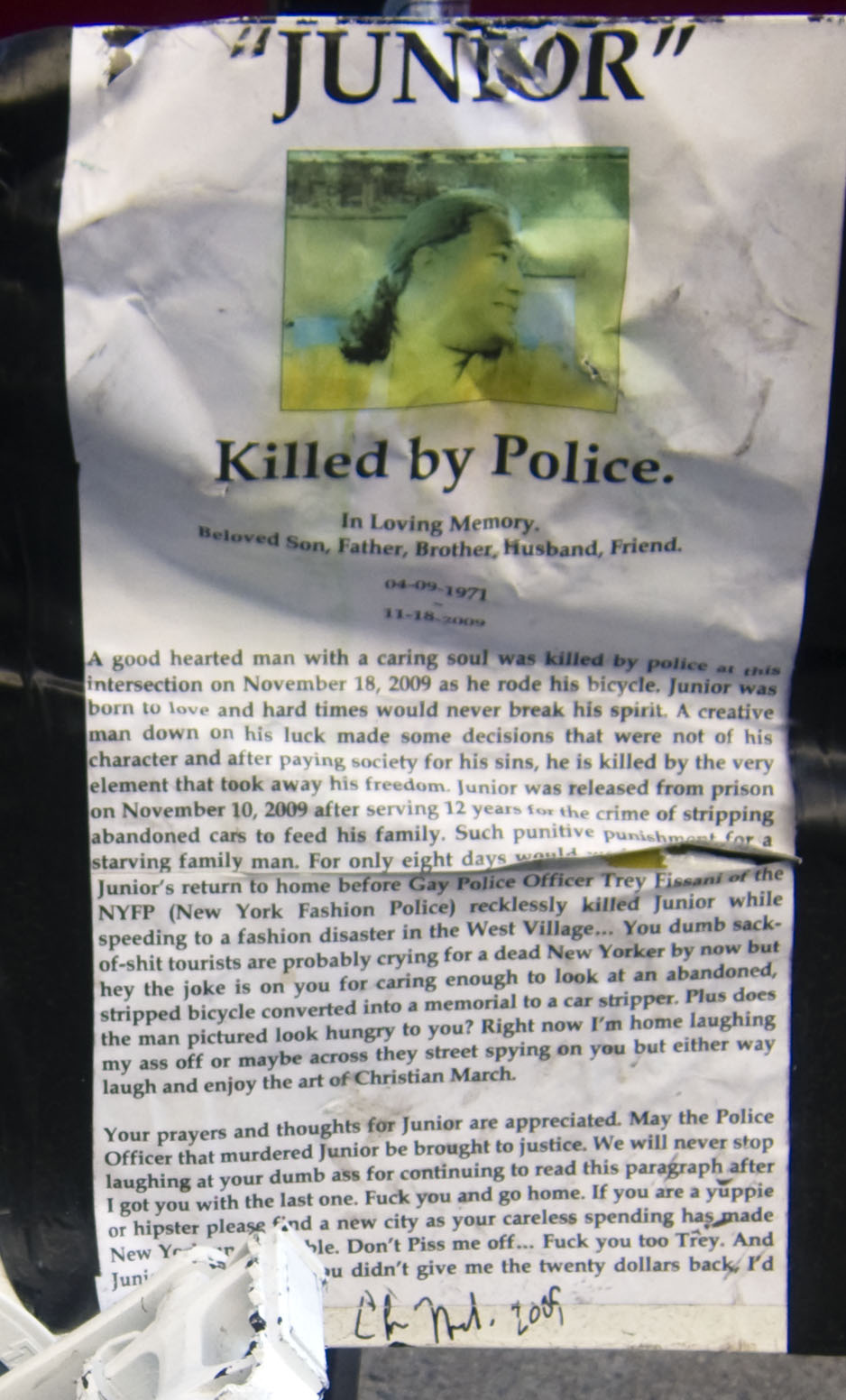
Seen near 1st Ave. and 9th St. in the East Village, this stripped down white bike that, on closer inspection, is someone’s elaborate ha-ha for passersby and I’m guessing the cyclists and cyclists’ families who paid their respect on the Fifth Annual Memorial Bike Ride this January 5. (Gothamist: At least 10 cyclist deaths were reported in NYC for 2009. In 2008, the number was 25).

A close up of the letter (click to read the text):
East Village: Prank Ghost Bike Memorial

An excerpt:

A good hearted man with a caring soul was killed by police at this intersection on November 18, 2009 as he rode his bicycle. Junior was born to love and ahrd times would never break his spirit. A creative man down on his luck made some decisions that were not of his character and after paying society for his sins, he is killed by the very element that took away his freedom. Junior was released from prison on November 10, 2009 after serving 12 years for the crime of stripping abandoned cars to feed his family. Such punitive punishment for a starving family man. For only eight days would…Junior’s return to home before Gay Police Officer Trey… of the NYFP (New York Fashion Police) recklessly killed Junior while speeding to a fashion disaster in the West Village…

You dumb sack-of-shit tourists are probably crying for a dead New Yorker by now but hey the joke is on you for caring enough to look at an abandoned, stripped bicycle converted into a memorial to a car stripper. Plus does the man pictured look hungry to you? Right now I’m home laughing my ass off or maybe across the street spying on you but either way laugh and enjoy the art of Christina March…

Fuck you and go home. If you are a yuppie or hipster find a new city as your careless spending has made New York …[unlivable]

A pretty good prank effort (as someone who had to write obits, I feel it’s pretty spot on how many people would eulogize a ne’er-do-well) though probably the time and energy could’ve gone to mocking something more mockable than killed cyclists, who, if they had their way in imposing traffic-calming measures, would probably make parts of the city more livable. And telling hipsters to go away? Isn’t this a joke that a hipster-amid-a-heroin-rehab-program might pull off to show how counter-culture and ironic and edgy he is? Agh, irony overload!

runningfromcamera.blogspot.com – “The rules are simple: I put the self-timer on 2 seconds, push the button and try to get as far from the camera as I can.”