Author Archives: Dan Nguyen

NYT: Anti-obesity tax will make soda more expensive than beer

Another one for the Department-of-Unintended-Consequences, from NYT’s City Room:

While the governor is taking aim at obesity caused by sugary drinks, Mr. Eusebio worries that the proposed tax would slim down the beverage industry, which he said pays $6.7 billion in wages statewide and generates billions more for the economy.

But he also mentioned some far smaller numbers that startled a soft-drink drinker.

“A six-pack of soda is going to cost you approximately $4.99” if the penny-an-ounce tax goes through, Mr. Eusebio said, “where you can pick up beer from $2.99 to $3.99.”

Off to the neighborhood supermarket, where it turned out that Mr. Eusebio’s math was not far off. With the tax, a six-pack of Coca-Cola or Pepsi would cost 2 cents more than a six-pack of the cheapest beer in the store.

To be fair, the “cheapest beer” apparently includes such brands as Old Milwaukee…and even the thriftiest, alcohol-friendly consumers will stay with Cola over that. But at $5.61 for a 6-pack of Coke (2 cents per ounce times 6 cans times 12 ounces, plus the 30 cent container tax) is pretty daunting no matter what the alternatives are.

(Update: Headline was reversed…)

NYT: Radiation (IMRT) horror stories; Woman has massive hole burned in chest because several doctors and physicists didn’t know “in” from “out”

Graphic: New York Times

Yet another case study on how the most educated of our professionals are not fail-safe. Not just not-fail-safe, but not not-able-to-tell-up-from-down-safe. The New York Times has an incredible story today, apparently one of many, into the dangers of new radiation treatment called Intensity Modulated Radiation Therapy.

It covers a lot of ground, but one anecdote that sticks out is of Alexandra Jn-Charles, who underwent IMRT to treat breast cancer. IMRT involves delivering radiation as a precise beam to kill a tumor…a great way to avoid the healthy-cell-killing symptoms of traditional radiation treatment.

However, Ms. Jn-Charles ended up with a hole in her chest so big that “you could just see my ribs in there.”

How did it happen? Numerous therapists, and even physicists, failed to notice a simple binary error:

One therapist mistakenly programmed the computer for “wedge out” rather than “wedge in,” as the plan required. Another therapist failed to catch the error. And the physics staff repeatedly failed to notice it during their weekly checks of treatment records.

Even worse, therapists failed to notice that during treatment, their computer screen clearly showed that the wedge was missing. Only weeks earlier, state health officials had sent a notice, reminding hospitals that therapists “must closely monitor” their computer screens.

The series of moronic, tragic errors calls to mind Atul Gawande’s story of the checklist, in which a 5-step list of tasks for doctors, as simple as washing their hands, reduced infection rate for a certain procedure to zero.

What’s the checklist for this cutting-edge radiation therapy?

Maybe there would be one if hospitals weren’t underreporting their accidents, according to NYC’s health department, by “several orders of magnitude.” (According to the NYT, the department apparently did not realize this until the Times started asking).

And then there’s the bad software angle. Varian Medical Systems gets criticized for code that, while allowing for the delivery of a precise and powerful stream of electrons to a tumor, has the stability and error-recovery ability of Windows ME. In the case of Mr. Jerome-Parks, an IMRT machine delivered radiation “from the base of his skull to his larynx” instead of just at the tumor. The reported problem: crash-prone software with poor/non-existent data recovery:

The investigation into what happened to Mr. Jerome-Parks quickly turned to the Varian software that powered the linear accelerator.

The software required that three essential programming instructions be saved in sequence: first, the quantity or dose of radiation in the beam; then a digital image of the treatment area; and finally, instructions that guide the multileaf collimator.

When the computer kept crashing, Ms. Kalach, the medical physicist, did not realize that her instructions for the collimator had not been saved, state records show. She proceeded as though the problem had been fixed.

“We were just stunned that a company could make technology that could administer that amount of radiation — that extreme amount of radiation — without some fail-safe mechanism,” said Ms. Weir-Bryan, Ms. Jerome-Parks’s friend from Toronto. “It’s always something we keep harkening back to: How could this happen? What accountability do these companies have to create something safe?”

Just incredible. Read the whole story here.

Also, a great animated graphic illustrating how IMRT can go awry.

My blog headline says “doctors” when it was “therapists” who apparently missed the “out” and “in” difference 27 times…though, presumably, doctors are involved somewhere in the operational process, even if they aren’t programming the machine themselves.

A NYT reader who says he’s an engineer has this insight:

What did Wedge in / Wedge out really imply to the software programmer? Did he understand the true consequences of the two setting options? Did he have any understanding of medicine at all? Or was his knowledge just limited to what the lines of software code could do?

This person might previously have written software for operating a sprinkler in a garden, where he provided options for turning the sprinkler on and off. Thus, a line of software code could manage Sprinkler On / Sprinkler Off. A similar line of code could also manage Wedge In / Wedge Out. The software is not really all that different; very often, all it does is activate/deactivate one or another relay. But what were the relative levels of importance of the selected options in these two cases? Sprinkler Off would mean the lawn didn’t get watered on one day. No big deal, and easily fixed. What about Wedge Out? Did he know what that could mean for the patient, and how many checks and verifications he would need to include for that in order to take into account situations like the operators of the equipment being mentally distracted, careless, etc.? Should he make lights to flash; warning sounds to be emitted; additional confirmational prompts and checklists each time? To make the system 100% foolproof, would the operator in this case require additional reminders / actions to be taken, which might not be required in the case of the gardener?

I think, now that technology is here to stay and since we are growing increasingly dependent on it, that every person in the chain, including electricians, mechanics, software programmers and others, need to become more medically aware of the implications of his/her particular role in the chain. They should no longer be distanced from the ultimate outcome as they are now, focussed on local actions and completion of job targets.

For instance, this programmer must be made aware that he is setting the radiation scope that could destroy a person. He must think deeply about practical issues and about how to take things like human error into account. He should not get away with just thinking he has met his daily target for number of lines of code written.

I usually don’t use the word “paradigm”, but I think what we need here is a major paradigm shift regarding what we should expect from technology and its providers in medicine. The old saying, “A chain is only as strong as its weakest link”, applies very strongly here.

American Express’s Security Problem: Awful password system

The NYT has a shocking story about a man who accidentally “hacked” his way into someone else’s American Express account. Allan Goldstein, an honest man, immediately called American Express’s customer support to notify them of the accidental breach. He got a rep in India, and then several others who had no clue what the issue was. It took more than twenty days later, six different American Express customer service reps, and a call from a New York Times writer for American Express to get on the ball.

This is the AmEx flack’s explanation:

Ms. Alfonso confirmed Mr. Goldstein’s story for me. She called the problem “an unusual case of two customers coincidentally having nearly identical log-in information, which led one card member to inadvertently log in to another card member’s account.”

Nearly identical log-in information? So perhaps Goldstein and this mystery lady’s account had the same name and the same password? What are the chances of that happening?

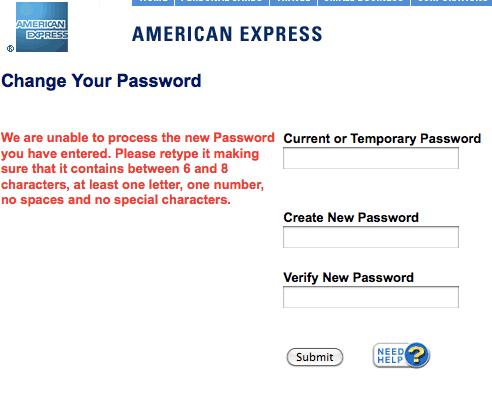
Well, pretty slim, but not out of this world, thanks to American Express’s astonishingly weak password protocols. I started an account with them more than a year ago and was amazed to find out that I could not create a password greater than 8 characters. I just checked, and it’s no different today:

Not only is it eight characters, but case doesn’t matter, and non-alphanumeric characters don’t work:

Your Password should:

* Contain 6 to 8 characters – at least one letter and one number (not case sensitive)
* Contain no spaces or special characters (e.g., &, >, *, $, @)
* Be different from your User ID and your last Password

Is there any other major online service today that has such a primitive, limited space for passwords? Eight alphanumeric characters was considered good enough back in the 1970s. Think about it; even your MySpace account has stronger security than your $10,000-limit credit card (ok, don’t know that for sure…it’s been awhile since I had a MySpace account).

Coincidentally, this week the NYT had a story about weak passwords, from a security analysis of the 32 million passwords stolen from the idiots at RockYou:

In the idealized world championed by security specialists, people would have different passwords for every Web site they visit and store them in their head or, if absolutely necessary, on a piece of paper.

But bowing to the reality of our overcrowded brains, the experts suggest that everyone choose at least two different passwords — a complex one for Web sites were security is vital, such as banks and e-mail, and a simpler one for places where the stakes are lower, such as social networking and entertainment sites.

Mr. Moss relies on passwords at least 12 characters long, figuring that those make him a more difficult target than the millions of people who choose five- and six-character passwords.

The problem with an eight-character alphanumeric password limit is that not only is there a limited choice of passwords, but you have less room to make easy-to-remember-but-secure passwords. For example, I’ve used phrases from favorite stories and songs. Something like: “itwastheBestOfTim3$” (this is not particularly secure, since it’s a composition of dictionary words, but you get the idea). So even though there is room for hundreds of billions of password combo…that space is only helpful if human beings can be relied on to generate random strings for passwords. The above NYT article suggests they can’t…so Joe Average, instead of being able to make up something like Password123456!, is limited by AmEx to Passwrd1. Neither is a very strong password, but there’s a chance for many more coincidental collisions in the latter case.

The terrible customer service that Mr. Goldstein experienced is galling…but the root of the problem, assuming the flack’s explanation is correct, is AmEx’s antiquated password-storage system. I hope they don’t keep it in plaintext, as the security-lax folks at RockYou did.

Snowulf wrote about this back in 2007.

Christmas Terror Bombing Hearings: So why don’t we just put EVERYONE on the no-fly list

From Politco (“Obama officials snipe at terror hearing”):

But Director of National Intelligence Dennis Blair fought back, arguing the no-fly list has been subject to political pressure to take names off the list because it was causing problems for ordinary citizens.

“The pressure since 2008 been to make it smaller,” he said. “Shame on us for giving into that pressure. We have now greatly expanded the no-fly list since what it was on Dec. 24.”

Boy, it just sounds like the only downside to expanding the no-fly list are annoying a few civil libertarians, right? What if those negative-nancies could be ignored? Would security be improved if we, say, put everyone on the list?

The most immediate downside to the average person is, of course, the increase in time at the security checkout and the number of strange hands patting you down.

But, the real kicker, is that after all that inconvenience, our security would most likely be worse.

At the end of the Politico article is this gem that reveals how the best-laid security plans fail because of one person’s clumsy fingers:

A worker in the American embassy in Nigeria misspelled Umar Farouk Abdulmutallab’s name when he searched a database to determine whether the young man had a valid U.S. visa, a senior State department official told the Senate Judiciary Committee Wednesday. That was Nov. 20, the day after Abdulmutallab’s father visited the embassy to warn U.S. officials that his son might be involved with radical extremists. The same worker sent a cable to intelligence officials with the correct spelling of the name, but it was incomplete because he hadn’t properly done the searches to realize that Abdulmutallab could get into the U.S.

A simple typo nearly doomed an entire passenger flight. How did this typo happen? Was it the end of the day and the worker was losing his boost from that last cup of coffee? What if it wasn’t a typo? What if the supervisor who gave the worker a name to look up had misspelled it?

The simple breakdown could’ve happened at any point in the information-sharing process.

And simple breakdowns happen more frequently as more tasks are in the pipeline. Think of Peter Provonost’s medical checklist: Doctors, the most rigorously educated members of our society, were killing patients because they failed to do something as simple as washing their hands with soap; a step easy to forget, perhaps, after treating dozens of patients in a day.

How much more likely is it that your average TSA/Homeland Security worker is going to bumble up a comparatively more complicated task, such as a thorough pat-down or a database record retrieval?

And how much does the chance of a screwup increase when the number of people to be patted-down/searched for increases significantly?

Recklessly expanding the no-fly list, or even having the belief that reducing the no-fly list is tantamount to reducing security, is not one that makes us safer.

China: Science, and “Avatar”

A couple of interrelated China articles on today’s NYT.com:

The first is a discussion on its “Room for Debate” blog on whether China will become a leader in science. The first writer, Gordon G. Chang, is a harsh skeptic:

China’s one-party state cannot produce world-class historians, economists, political thinkers or even demographers. Beijing’s increasing demand for obedience smothers creativity in many of the social sciences and “soft” disciplines.

Meanwhile, in the World section, there’s an article titled China to Pull Back ‘Avatar’ for Domestic Film .

“Avatar,” the Hollywood blockbuster that has proven wildly popular with Chinese moviegoers, will be pulled in the next few days from the majority of Chinese theaters where it is showing, Chinese media outlets reported Tuesday.

The film, which can be viewed in standard format or in 3-D, will be yanked from theaters without 3-D technology in order to make way for a domestically produced biography of Confucius, according to reports in state-controlled media that mainly quote theater operators.

“Avatar” seemed like the one feature that could overcome the alleged depressing effect that China’s piracy has on ticket sales. Personally, I can’t imagine “Avatar” being worthwhile at all except for seeing it in 3D on the big screen. Chinese culture bureaucrats apparently don’t think a movie about one of their country’s greatest philosophers can attract more yuan than a movie about half-naked blue people. They’re probably right; a movie featuring George Washington traveling forward in time to kill Hitler probably would draw less American viewers than “Avatar.” But let the people decide, and let the moviemakers be pushed to innovate (a 2009 foreign language movie about Brad Pitt launching an operation to kill Hitler didn’t do too shabby, thanks to a ballsy director).

Science is a different field than art, but it’s hard to believe that the heavy-handed mindset that quashes innovation in one field won’t hesitate to do it in the other.

Hell on Earth: Haiti Coverage

The Haiti earthquake’s aftermath is so horrible that an anecdote like this, which would be the tragic center point for virtually any other kind of story in the NYT, barely registers until you read it over again (“Looting Flares Where Authority Breaks Down “):

“We are all in a bad way,” said Margaret Cherubin, 41, a merchant who lost her husband, Jimmy, and three children in the earthquake. She said she was afraid to return to work because of her fear of thieves. “I have no family, just the clothing on my back,” she said. “I now live with God only.”

The closing anecdote ends up being even more horrific.

NYT photog Damon Winter, in this Q&A on the Lens blog, talks about one moment that didn’t get captured on camera:

There was one thing that didn’t really make pictures. It was my first night here last night. We were staying at a hotel on the edge of a pretty heavily damaged neighborhood and at night, you could hear people singing.

People are out on the street at night. It’s really hard to photograph because there’s no electricity. It’s pitch black. But all night you could hear them singing prayers. It’s pretty amazing the ways that people are dealing with this tragedy. It says a lot about the Haitian character. They are an amazing people.

Glenn Beck: You are not Howard Beale, so stop ruining one of my favorite movies

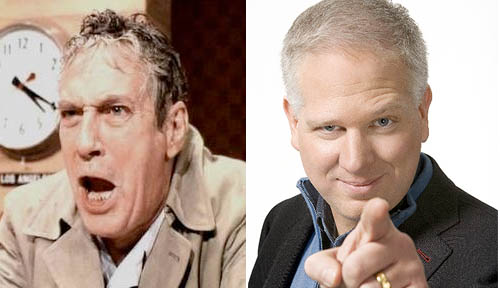
"Network's" Howard Beale; Glenn Beck

OK, dislike me for this, but Glenn Beck and his rantings don’t automatically drive me into a tizzy. Granted, I almost never see him outside of YouTube highlight clips, so I’m not that familiar with his reportedly controversial opinions. But I’m not opposed to his general libertarian bent or his call to be skeptical of authority (I’ll give him the benefit of the doubt, as I do to Jon Stewart, that when the pendulum of power swings to the right, he’ll attempt to be just as contrarian).

But it really bugs me is when he claims he’s a real-life Howard Beale. Anyone, red-state or blue, should be able to see that as an awfully ignorant interpretation of Beale and Network, a movie which prophesized the sensationalism-of-news-networks-for-ratings that, incidentally, Beck today gets accused of.

From today’s interview with Wall Street Journal’s James Taranto (‘Nobody’s Watching Charlie Rose’ ):

Mr. Beck identifies with the Howard Beale character from the 1976 film “Network.” Beale, played by Peter Finch, is a news anchor on a fictional broadcast network who has a nervous breakdown on air, becomes a raving populist, and is a big hit with viewers. Mr. Beck invokes the fictional anchorman’s most famous line: “I am mad as hell, and I’m not going to take it anymore. The part of Howard Beale that I liken myself to is the moment when he was in the raincoat, where he figures everything out, and he’s like, ‘Whoa, whoa, wait a minute! Why the hell aren’t you up at the window shouting outside?'”

OK, besides the fact that both rant loudly against The Man, Beck does share a similar down-in-the-dumps broadcasting background story with Beale. By his own claim, Beck, after reaching success in broadcast at an early age, hit bottom at 30 with a bout of alcoholism: “I was suicidal, lost my family—I mean, it was bad.”

But Beck apparently only values Beale as a TV prophet unafraid to tell the truth, not considering the actual truth that Beale tells. Beale’s undoing, according to Beck, is that he becomes a sell-out:

Mr. Beck adds, “What the media wants to make me is the Howard Beale at the end, the crazy showman that’s doing anything for money. That I don’t liken myself to.”

But Beale does not become a failed figure because he ends up “doing anything for money.” His show is abruptly – and violently – taken “off-air” because he ends up speaking a truth so horribly depressing about the “college of corporations” and the overall empty existence of humankind that his show no longer attracts good ratings.

There was no selling-out – it’s the exact opposite, actually – only a point in which Beale moved from yelling-at-the-Man to lamenting how little impact and control even the angriest of people have over society’s immutable order. In fact, if Beck’s interpretation were correct, it would mean that Beale reached his apex of truth when he tried to get his viewers to write the White House to stop his network’s pending takeover by a Saudi Arabian conglomerate (not exactly a libertarian or capitalistic cause). Does this mean that someday we’ll be treated to the spectacle of Beck flipping out over a business deal by Rupert Murdoch and News Corp?

I don’t mind that Beck is making millions from being a red-meat populist. But if he’s going to compare himself to Howard Beale, a character who meets his demise because he can’t shut up about the awful truth, he needs to go a further than just telling people to get mad (at things/people they were already inclined to be pissed at). For instance, this financially-suicidal rant about the role of television:

But, man, you’re never going to get any truth from us. We’ll tell you anything you want to hear; we lie like hell. We’ll tell you that, uh, Kojak always gets the killer, or that nobody ever gets cancer at Archie Bunker’s house, and no matter how much trouble the hero is in, don’t worry, just look at your watch; at the end of the hour he’s going to win. We’ll tell you any shit you want to hear. We deal in *illusions*, man! None of it is true! But you people sit there, day after day, night after night, all ages, colors, creeds… We’re all you know. You’re beginning to believe the illusions we’re spinning here. You’re beginning to think that the tube is reality, and that your own lives are unreal. You do whatever the tube tells you! You dress like the tube, you eat like the tube, you raise your children like the tube, you even *think* like the tube! This is mass madness, you maniacs! In God’s name, you people are the real thing! *WE* are the illusion! So turn off your television sets. Turn them off now. Turn them off right now. Turn them off and leave them off! Turn them off right in the middle of the sentence I’m speaking to you now! TURN THEM OFF…