“As I speak to you today, government censors somewhere are working furiously to erase my words from the records of history. But history itself has already condemned these tactics.”
Christmas Terror Bombing Hearings: So why don’t we just put EVERYONE on the no-fly list
From Politco (“Obama officials snipe at terror hearing”):
But Director of National Intelligence Dennis Blair fought back, arguing the no-fly list has been subject to political pressure to take names off the list because it was causing problems for ordinary citizens.
“The pressure since 2008 been to make it smaller,” he said. “Shame on us for giving into that pressure. We have now greatly expanded the no-fly list since what it was on Dec. 24.”
Boy, it just sounds like the only downside to expanding the no-fly list are annoying a few civil libertarians, right? What if those negative-nancies could be ignored? Would security be improved if we, say, put everyone on the list?
The most immediate downside to the average person is, of course, the increase in time at the security checkout and the number of strange hands patting you down.
But, the real kicker, is that after all that inconvenience, our security would most likely be worse.
At the end of the Politico article is this gem that reveals how the best-laid security plans fail because of one person’s clumsy fingers:
A worker in the American embassy in Nigeria misspelled Umar Farouk Abdulmutallab’s name when he searched a database to determine whether the young man had a valid U.S. visa, a senior State department official told the Senate Judiciary Committee Wednesday. That was Nov. 20, the day after Abdulmutallab’s father visited the embassy to warn U.S. officials that his son might be involved with radical extremists. The same worker sent a cable to intelligence officials with the correct spelling of the name, but it was incomplete because he hadn’t properly done the searches to realize that Abdulmutallab could get into the U.S.
A simple typo nearly doomed an entire passenger flight. How did this typo happen? Was it the end of the day and the worker was losing his boost from that last cup of coffee? What if it wasn’t a typo? What if the supervisor who gave the worker a name to look up had misspelled it?
The simple breakdown could’ve happened at any point in the information-sharing process.
And simple breakdowns happen more frequently as more tasks are in the pipeline. Think of Peter Provonost’s medical checklist: Doctors, the most rigorously educated members of our society, were killing patients because they failed to do something as simple as washing their hands with soap; a step easy to forget, perhaps, after treating dozens of patients in a day.
How much more likely is it that your average TSA/Homeland Security worker is going to bumble up a comparatively more complicated task, such as a thorough pat-down or a database record retrieval?
And how much does the chance of a screwup increase when the number of people to be patted-down/searched for increases significantly?
Recklessly expanding the no-fly list, or even having the belief that reducing the no-fly list is tantamount to reducing security, is not one that makes us safer.
China: Science, and “Avatar”
A couple of interrelated China articles on today’s NYT.com:
The first is a discussion on its “Room for Debate” blog on whether China will become a leader in science. The first writer, Gordon G. Chang, is a harsh skeptic:
China’s one-party state cannot produce world-class historians, economists, political thinkers or even demographers. Beijing’s increasing demand for obedience smothers creativity in many of the social sciences and “soft†disciplines.
Meanwhile, in the World section, there’s an article titled China to Pull Back ‘Avatar’ for Domestic Film .
“Avatar,†the Hollywood blockbuster that has proven wildly popular with Chinese moviegoers, will be pulled in the next few days from the majority of Chinese theaters where it is showing, Chinese media outlets reported Tuesday.
The film, which can be viewed in standard format or in 3-D, will be yanked from theaters without 3-D technology in order to make way for a domestically produced biography of Confucius, according to reports in state-controlled media that mainly quote theater operators.
“Avatar” seemed like the one feature that could overcome the alleged depressing effect that China’s piracy has on ticket sales. Personally, I can’t imagine “Avatar” being worthwhile at all except for seeing it in 3D on the big screen. Chinese culture bureaucrats apparently don’t think a movie about one of their country’s greatest philosophers can attract more yuan than a movie about half-naked blue people. They’re probably right; a movie featuring George Washington traveling forward in time to kill Hitler probably would draw less American viewers than “Avatar.” But let the people decide, and let the moviemakers be pushed to innovate (a 2009 foreign language movie about Brad Pitt launching an operation to kill Hitler didn’t do too shabby, thanks to a ballsy director).
Science is a different field than art, but it’s hard to believe that the heavy-handed mindset that quashes innovation in one field won’t hesitate to do it in the other.
Free at last

Hell on Earth: Haiti Coverage
The Haiti earthquake’s aftermath is so horrible that an anecdote like this, which would be the tragic center point for virtually any other kind of story in the NYT, barely registers until you read it over again (“Looting Flares Where Authority Breaks Down “):
“We are all in a bad way,†said Margaret Cherubin, 41, a merchant who lost her husband, Jimmy, and three children in the earthquake. She said she was afraid to return to work because of her fear of thieves. “I have no family, just the clothing on my back,†she said. “I now live with God only.â€
The closing anecdote ends up being even more horrific.
NYT photog Damon Winter, in this Q&A on the Lens blog, talks about one moment that didn’t get captured on camera:
There was one thing that didn’t really make pictures. It was my first night here last night. We were staying at a hotel on the edge of a pretty heavily damaged neighborhood and at night, you could hear people singing.
People are out on the street at night. It’s really hard to photograph because there’s no electricity. It’s pitch black. But all night you could hear them singing prayers. It’s pretty amazing the ways that people are dealing with this tragedy. It says a lot about the Haitian character. They are an amazing people.
Glenn Beck: You are not Howard Beale, so stop ruining one of my favorite movies
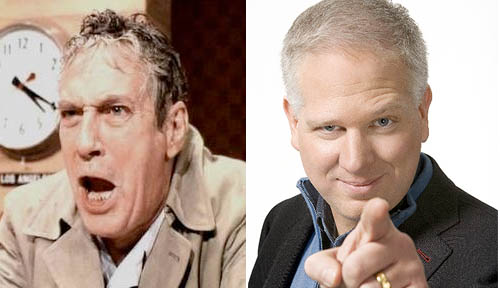
OK, dislike me for this, but Glenn Beck and his rantings don’t automatically drive me into a tizzy. Granted, I almost never see him outside of YouTube highlight clips, so I’m not that familiar with his reportedly controversial opinions. But I’m not opposed to his general libertarian bent or his call to be skeptical of authority (I’ll give him the benefit of the doubt, as I do to Jon Stewart, that when the pendulum of power swings to the right, he’ll attempt to be just as contrarian).
But it really bugs me is when he claims he’s a real-life Howard Beale. Anyone, red-state or blue, should be able to see that as an awfully ignorant interpretation of Beale and Network, a movie which prophesized the sensationalism-of-news-networks-for-ratings that, incidentally, Beck today gets accused of.
From today’s interview with Wall Street Journal’s James Taranto (‘Nobody’s Watching Charlie Rose’ ):
Mr. Beck identifies with the Howard Beale character from the 1976 film “Network.” Beale, played by Peter Finch, is a news anchor on a fictional broadcast network who has a nervous breakdown on air, becomes a raving populist, and is a big hit with viewers. Mr. Beck invokes the fictional anchorman’s most famous line: “I am mad as hell, and I’m not going to take it anymore. The part of Howard Beale that I liken myself to is the moment when he was in the raincoat, where he figures everything out, and he’s like, ‘Whoa, whoa, wait a minute! Why the hell aren’t you up at the window shouting outside?'”
OK, besides the fact that both rant loudly against The Man, Beck does share a similar down-in-the-dumps broadcasting background story with Beale. By his own claim, Beck, after reaching success in broadcast at an early age, hit bottom at 30 with a bout of alcoholism: “I was suicidal, lost my family—I mean, it was bad.”
But Beck apparently only values Beale as a TV prophet unafraid to tell the truth, not considering the actual truth that Beale tells. Beale’s undoing, according to Beck, is that he becomes a sell-out:
Mr. Beck adds, “What the media wants to make me is the Howard Beale at the end, the crazy showman that’s doing anything for money. That I don’t liken myself to.”
But Beale does not become a failed figure because he ends up “doing anything for money.” His show is abruptly – and violently – taken “off-air” because he ends up speaking a truth so horribly depressing about the “college of corporations” and the overall empty existence of humankind that his show no longer attracts good ratings.
There was no selling-out – it’s the exact opposite, actually – only a point in which Beale moved from yelling-at-the-Man to lamenting how little impact and control even the angriest of people have over society’s immutable order. In fact, if Beck’s interpretation were correct, it would mean that Beale reached his apex of truth when he tried to get his viewers to write the White House to stop his network’s pending takeover by a Saudi Arabian conglomerate (not exactly a libertarian or capitalistic cause). Does this mean that someday we’ll be treated to the spectacle of Beck flipping out over a business deal by Rupert Murdoch and News Corp?
I don’t mind that Beck is making millions from being a red-meat populist. But if he’s going to compare himself to Howard Beale, a character who meets his demise because he can’t shut up about the awful truth, he needs to go a further than just telling people to get mad (at things/people they were already inclined to be pissed at). For instance, this financially-suicidal rant about the role of television:
But, man, you’re never going to get any truth from us. We’ll tell you anything you want to hear; we lie like hell. We’ll tell you that, uh, Kojak always gets the killer, or that nobody ever gets cancer at Archie Bunker’s house, and no matter how much trouble the hero is in, don’t worry, just look at your watch; at the end of the hour he’s going to win. We’ll tell you any shit you want to hear. We deal in *illusions*, man! None of it is true! But you people sit there, day after day, night after night, all ages, colors, creeds… We’re all you know. You’re beginning to believe the illusions we’re spinning here. You’re beginning to think that the tube is reality, and that your own lives are unreal. You do whatever the tube tells you! You dress like the tube, you eat like the tube, you raise your children like the tube, you even *think* like the tube! This is mass madness, you maniacs! In God’s name, you people are the real thing! *WE* are the illusion! So turn off your television sets. Turn them off now. Turn them off right now. Turn them off and leave them off! Turn them off right in the middle of the sentence I’m speaking to you now! TURN THEM OFF…
Need a Flash gallery solution for your own hosted photos? Try DepGal 0.1

Yep, another flash photo gallery, but one that is focused on being fast, easy to update, and relatively-free of clutter that distracts from the photos.
I created DepGal for my own portfolio but figure everyone else might find some use for it. At some point, I’ll open-source it, after I clean up the code and get more feedback from the community.
Big Picture: Haiti’s Earthquake

32 An injured person is seen in the street after an earthquake hit Port-au-Prince, Haiti, Tuesday, Jan. 12, 2010. (AP Photo/Jorge Cruz) #
As expected, the Boston Globe’s Big Picture has an astounding collection of photos from the 7.0 quake in Haiti.
Roger Ebert: The joy of making out, and how we got here
Roger Ebert, my favorite movie-and-everything-else critic, gives some historical perspective on America’s road to sexual freedom and enjoyment. He spotlights a letter to the Daily Illini, written by an assistant professor of biology, that sparked off a national furor in 1960, but has since been forgotten, even by Wikipedia.
The letter:
With modern contraceptives and medical advice readily available at the nearest drugstore, or at least a family physician, there is no valid reason why sexual intercourse should not be condoned among those sufficiently mature to engage in it without social consequences and without violating their own codes of morality and ethics. A mutually satisfactory sexual experience would eliminate the need for many hours of frustrating petting and lead to happier and longer lasting marriages among our young men and women.
Google publicly calls out China over hacking of human rights advocates’ accounts
On the Google Blog, Google’s chief legal counsel David Drummond reveals that a “highly sophisticated and targeted” attack on its corporate infrastructure was traced back to China. The objective, Google believes, was to compromise the GMail accounts of Chinese human-rights activists (two were accessed, Google believes, with no actual content revealed).
This attack has apparently put a bug in Google’s conscience; Drummond writes that they are no longer willing to self-censor Google.cn:
These attacks and the surveillance they have uncovered–combined with the attempts over the past year to further limit free speech on the web–have led us to conclude that we should review the feasibility of our business operations in China. We have decided we are no longer willing to continue censoring our results on Google.cn, and so over the next few weeks we will be discussing with the Chinese government the basis on which we could operate an unfiltered search engine within the law, if at all. We recognize that this may well mean having to shut down Google.cn, and potentially our offices in China.