This artist who did an all-black canvas is pretty good, even though he had to actually buy paint to get his artwork into the MoMA:

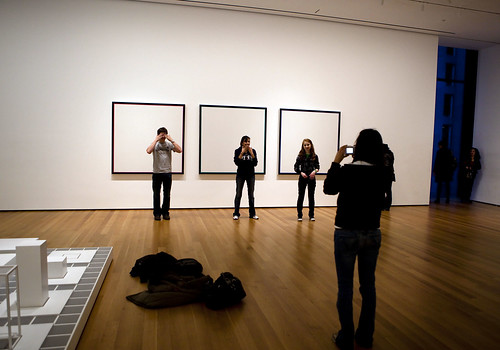
This artist who did an all-black canvas is pretty good, even though he had to actually buy paint to get his artwork into the MoMA:
Besides that, how was the play Mrs. Lincoln? Or…”Besides that, Mr. Fuld, how low was your gas bill?”
Gas prices have risen $1 since just after President Obama took office in January 2009 and are now closing in on the $3 mark, prompting an evaluation of the administration’s energy record and calls for the White House to open more U.S. land for oil exploration.
…
Gas prices have been on a roller-coaster ride over the past decade, dropping to near $1 after President George W. Bush’s first year in office, crossing the $2 mark in 2005 and reaching $4 in June 2008 before Congress and Mr. Bush took action, lifting presidential and congressionally imposed moratoriums on expanding offshore drilling on the Outer Continental Shelf.
Mr. Bush lifted the presidential moratorium in July that year. The congressional moratorium expired Sept. 30, and prices fell precipitously, dropping more than $1 in October.
I wonder what else fell precipitously in September of 2008…besides demand for Lehman Brothers stocks
 A remarkable bit of FOIA lore from Harper’s, in a post on the Pentagon vs. WikiLeaks (the latest fight is apparently about what Wikileaks says is decrypted video of an airstrike):
Which young Illinois legislator, who would become a rising, polarizing star in American and world politics in the 2000s, was a fervent advocate of the right to access government records?
In a debate over the Freedom of Information Act, a young Congressman from Illinois spoke in favor of freeing public records:
[It] “will make it considerably more difficult for secrecy-minded bureaucrats to decide arbitrarily that people should be denied access to information on the conduct of government or to how a …. government official is handling his job. Public records, which are the evidence of official government action, are public property, and there should be a positive obligation to disclose this information upon request.”
The same Congressman also said in that debate:
“We have said that ours is a government guided by citizens…From this it follows that government will serve us well only if the citizens are well informed.â€
A final clue: To the White House, who opposed the bill, the Illinois congressman stated (PDF):
The unanimous action after years of delay [in passing FOIA] results from the growing size and complexity of the federal government, from its increased role in our lives, and from the increasing awareness of Americans of the threat involved in government secrecy on vital records effecting their fate.
With the continuing tendency toward managed news and suppression of public information that the people are entitled to have, the issues have at last been brought home forcefully to the public.
The name of the gentleman from Illinois: Donald Rumsfeld.
At the time of the 1966 debate and passage of FOIA, Rumsfeld was in the opposition party; the Republicans hoped that FOIA, besides ostensibly improving the operations of government with transparency, would uncover information that would embarrass Pres. Lyndon Johnson. Johnson so opposed FOIA that he refused to have a signing ceremony for the bill and tacked on a signing statement (PDF) that undercut the law based on national security concerns.
A decade after FOIA’s passage, Rumsfeld was President Ford’s chief of staff. He, along with Dick Cheney and Antonin Scalia, convinced Ford to veto amendments that were intended to strengthen FOIA. The veto was overridden in the House, though, by a margin of 371-31.
About two decades after that, Rumsfeld would become the chatty, document-divulging, and otherwise champion of transparency and Secretary of Defense who the press would come to adore and cherish.
In his resignation letter to President Bush, Rumsfeld wrote that how his only regret was that he did not do even more to keep government free and open. Oh wait…

Loved this story in the New York Times about the loathing, self-loathing, and helplessness in the real-estate crash, epitomized by the residents on a single Arizona street racked with foreclosures.
She said she did not feel she deserved to have her debts forgiven, but added that if her mortgage had been lowered, she would have tried harder to stay. The worst part, she said, is that her decision will hurt Mr. Setbacken, who has watched out for her over the years. “For Gary, he’s going to have to deal with the ramifications of what I’m doing because I’m bringing his property value down,†she said. “I pray at church. I feel horrible for what I’m doing to my neighbors.â€
It’s easy to be angry and unsympathetic towards the homeowners who bought beyond their means and accelerated the housing crisis. But as the change of heart in one of this story’s residents argues, it’s not a practical solution and it’s not a human response.
The great weather from the first spring weekend didn’t last long. But a warm rain is still pleasant
Came across this wikipedia article on Kin Ung-Yong (mentioned in this Reddit discussion on why The Big Lebowski is so great): Kim was in the Guinness Book of World Records for highest IQ (210), could read four languages by the age of 3, and earned his PhD in Physics before 16. However, he settled for being a professor in civil engineering at a mediocre university, just so he could live a normal life.
A 1995 article by the NYT’s Nicholas Kristof, with an unforgettable, chilling lede:
ORIOKA, Japan— He is a cheerful old farmer who jokes as he serves rice cakes made by his wife, and then he switches easily to explaining what it is like to cut open a 30-year-old man who is tied naked to a bed and dissect him alive, without anesthetic.
“The fellow knew that it was over for him, and so he didn’t struggle when they led him into the room and tied him down,” recalled the 72-year-old farmer, then a medical assistant in a Japanese Army unit in China in World War II. “But when I picked up the scalpel, that’s when he began screaming.
And this dark humor:
Japan’s biological weapons program was born in the 1930’s, in part because Japanese officials were impressed that germ warfare had been banned by the Geneva Convention of 1925. If it was so awful that it had to be banned under international law, the officers reasoned, it must make a great weapon.
And the relevance today, if you believe that those who forget history are doomed to repeat it:
The research was kept secret after the end of the war in part because the United States Army granted immunity from war crimes prosecution to the doctors in exchange for their data. Japanese and American documents show that the United States helped cover up the human experimentation. Instead of putting the ringleaders on trial, it gave them stipends.
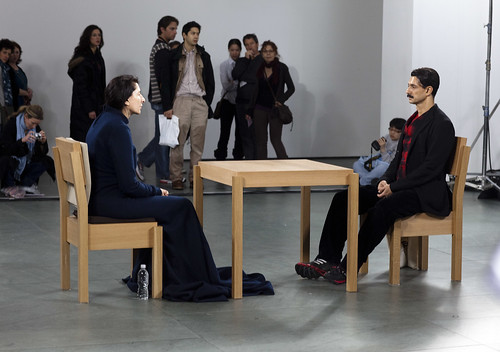
Never been a fan of performance art, but it is worth an afternoon at the MOMA. The top floor exhibition has some interesting videos and live art of people slapping each other and being naked.
From the MOMA description:
Abramović, best known for her durational works, has created a new work for this performance retrospective—The Artist Is Present (2010)—that she will perform daily throughout the run of the exhibition, for 77 days and a total of over 700 hours. For her longest solo piece to date, Abramović sits in silence at a table in the Museum’s Donald B. and Catherine C. Marron Atrium during public hours, passively inviting visitors to take the seat across from her for as long as they choose within the timeframe of the Museum’s hours of operation. Although she will not respond, participation by Museum visitors completes the piece and allows them to have a personal experience with the artist and the artwork.



Maid-Rite...mmmm....Loose Meat
New York refuses to give homosexuals equal marriage rights and, with that work out of the way, has moved on* to trying to ban salt from restaurants so that, I don’t know, no one ever has to die, ever…or enjoy life, in general, or something.
Meanwhile, Iowa lets gays marry and its state senate just approved a measure that protects the traditional-but-possibly-dangerous-bacteria-friendly method of cooking Iowa’s signature sandwich, the Maid-Rite…because that’s how a proper “loose meat” sandwich is done in there parts.
A majority of senators sided with the Maid-Rite in Marshalltown to override concerns from state food-safety inspectors who question the restaurant’s cooking methods.
Some senators chafed at what they perceived as an attack on an Iowa icon and argued that the cooking method this Maid-Rite outlet has used for 82 years should be preserved.
“Maid-Rites are very important to me,” Sen. Dennis Black, D-Grinnell, said Wednesday. “I’m unaware of a single person that’s ever gotten sick from a Maid-Rite.”
The Iowa Department of Inspections and Appeals has told Taylor’s Maid-Rite restaurant that it must alter its process for cooking loose-meat sandwiches. The process at Taylor’s involves cooked hamburger being placed in the same heated receptacle that’s used to cook raw meat.
Iowa 2, New York 0.
*OK, it’s just one Brooklyn legislator for now. But that a state lawmaker would even waste his time pitching such a health-nanny proposal, even as a PR stunt, speaks a little to the Empire State’s views on the reach of law and personal health. Gov. Paterson** proposed a soda tax before abandoning it in the face of unpopular opinion. Bloomberg is now petitioning the state to allow him to tax soda in NYC, which, according to a New York Times back-of-the-napkin analysis, would make soda more expensive than some beers.
** Also, recent Iowa governors have so far avoided consorting with top-dollar prostitutes. And not having aides who allegedly beat up their girlfriends and have the state police cover it up.