The SOPA Debate and How It’s Affected by Congress’s Understanding of Child Porn

Rep. Lamar Smith, chairman of the House Judiciary Committee and SOPA sponsor

Rep. Lamar Smith, chairman of the House Judiciary Committee and SOPA sponsor

Update (1/22/2012): SOPA was indefinitely postponed by Rep. Lamar Smith on Friday (PIPA is likewise stalled). Rep. Smith also has another Internet rights bill on deck though: the The Protecting Children from Internet Pornographers Act of 2011, which mandates that Internet services store customer data for up to 18 months to make it easier for law enforcement to investigate them for child porn trafficking. This proposed bill is discussed in the latter half of this post, including how its level of support is similar (and different) than SOPA’s.

H.R. 1981 has made it farther than SOPA did. It made it out of the Judiciary Committee (which is chaired by Rep. Lamar Smith and also handled SOPA) with a 19-10 vote in July of last year and is placed on the Union Calendar. Compare HR.1981’s progress compared to SOPA’s). H.R. 1981 has 39 cosponsors, compared to SOPA’s original 31. Read the text of HR 1981.

One thing I’ve learned from the whole SOPA affair is how obscure our lawmaking process is even in this digital age. The SOPA Opera site I put up doesn’t do anything but display publicly available information: which legislators support/oppose SOPA and why. But it still got a strong reaction from users, possibly because they misunderstand our government’s general grasp of technology issues.

Sen. Al Franken

Sen. Al Franken is one of the co-sponsors for PROTECT-IP, the Senate's version of SOPA

The most common refrain I saw was: “I cannot believe that Rep/Senator [insert name] is for SOPA! [insert optional expletive].” In particular, “Al Franken” was a frequently invoked name because his fervent advocacy on net neutrality seemed to make the Minnesota senator, in many of his supporters’ opinions, an obvious enemy of SOPA. In fact, one emailer accused me of being out to slander Franken, even though the official record shows that Franken has spoken strongly for PROTECT-IP (the Senate version of SOPA) and even co-sponsored it.

So there’s been a fair amount of confusion as to what mindset is responsible for SOPA. Since party lines can’t be used to determine the rightness/wrongess of SOPA, fingers have been pointed at the money trail: SOPA’s proponents reportedly receive far more money from media/entertainment-affiliated donors than they do from the tech industry. The opposite trend exists for the opponents.

It’s impossible of course to know exactly what’s in the our legislators’ minds. But a key moment during the Nov. 16 House Judiciary hearing on SOPA suggest that their opinions may be rooted less in malice/greed (if you’re of the anti-SOPA persuasion) than in something far more prosaic: their level of technological comprehension.

You can watch the entire, incredibly-inconvenient-to-access webcast at the House Judiciary’s hearing page. I’ve excerpted a specific clip in which Rep. Tom Marino (R-PA) is asking Katherine Oyama (Google’s copyright lawyer) about why Google can stop child porn but not online piracy:

REP. MARINO: I want to thank Google for what it did for child pornography – getting it off the website. I was a prosecutor for 18 years and I find it commendable and I put those people away. So if you can do that with child pornography, why can you not do it [with] these rogue websites [The Pirate Bay, et al.]? Why not hire some whiz kids out of college to come in and monitor this and work for the company to take these off?

My daughter who is 16 and my son who is 12, we love to get on the Internet and we download music and we pay for it. And I get to a site and I say this is a new one, this is good, we can get some music here. And my daughter says Dad, don’t go near that one. It’s illegal, it’s free, and given the fact that you’re on Judiciary, I don’t think you should be doing that…Maybe we need to hire her [laugh]…but, why not?


OYAMA: The two problems are similar in that they’re both very serious problems they’re both things that we all should be working to fighting against. But they’re very different in how you go about combatting it. So for child porn, we are able to design a machine that is able to detect child porn. You can detect certain colors that would show up in pornography, you can detect flesh tones. You can have manual review, where someone would look at the content and they would say this is child porn and this shouldn’t appear.

We can’t do that for copyright just on our own. Because any video, any clip of content, it’s going to appear to the user to be the same thing. So you need to know from the rights holder…have you licensed it, have you authorized it, or is this infringement?”


REP. MARINO: I only have a limited amount of time here and I appreciate your answer. But we have the technology, Google has the technology, we have the brainpower in this country, we certainly can figure it out.

The subject of child pornography is so awful that it’s little wonder that no one really thinks about how it’s actually detected and stopped. As it turns out, it’s not at all complicated.

When I was a college reporter, I had the idea to drive down to the county district attorney’s office and go through all the search warrants. Search warrants become part of the public record, but district attorneys can seal them if police worry that details in an affidavit or search warrant would jeopardize an investigation. I wanted to count how many times this was done at the county DA, because some major cases had been sealed for months. And I wondered if the DA was too overzealous in keeping private what should be the people’s business.

But there were plenty of big cases among the unsealed warrants. I went to college in a small town but there was a bizarre, seemingly constant stream of students being charged with child porn possession. Either college students were becoming particularly perverse or the campus police happened to be crack cyber-sleuths in rooting out the purveyors.

I don’t know about the former, but I learned that the police were not particularly skilled at hacking, based on their notes in the search warrants. In fact, finding the suspects was comically easy because of the unique setup of our college network. Everyone in the dorms had an ethernet hookup but there was no Google, Napster or BitTorrent at the time. So one of the students built a search engine that allowed any student to search the shared files of every other student. And since Windows apparently made this file sharing a default (and at the time, 90+ percent of students’ computers were PCs), the student population had inadvertent access to a huge breadth of files, including MP3s and copied movies and even homework papers.

So to find out if anyone had child porn, the police could just log onto the search engine and type in the appropriate search terms. But the police didn’t even have to do this. Other students would stumble upon someone’s porn collection (you had the option of exploring anyone’s entire shared folder, not just files that came up on the search) and report it. The filenames were all the sickening indication needed to suspect someone of possession.

Google’s Oyama alludes to more technically sophisticated ways of detecting it, but the concept is just as simple as it was at my college: no matter how it’s found, child pornography is easy to categorize as child porn because of its visual characteristics, whether it’s the filename or the images itself. In fact, it’s not even necessary for a human to view a suspected file to know (within a high mathematical probability) that it contains the purported illegal content.

If you’ve ever used Shazam or any of the other song-recognition services, you’ve put this concept into practice. When you hold up a phone to identify a song playing over the bar’s speakers, it’s not as if your phone dials up one of Shazam’s resident music experts who then responds with her guess of the song. The Shazam app looks for certain high points (as well as their spacing, i.e. the song’s rhythm) to generate a “fingerprint” of the song, and then compares it against Shazam’s master database of song “fingerprints”.

No human actually has to “listen” to the song. This is not a new technological concept; it’s as old as, well, the fingerprint database used by law enforcement.

So what Rep. Marino essentially wants is for Google to build a Shazam-like service that doesn’t just identify a song by “listening” to it, but also determines if whoever playing that song has the legal right to do so. Thus, this anti-pirate-Shazam would have to determine from the musical signature of a song such things as whether it came from an iTunes or Amazon MP3 or a CD. And not only that, it would have to determine whether or not the MP3 or CD is a legal or illegal copy.

In a more physical sense, this is like detecting a machine that can determine from a photograph of your handbag whether it’s a cheap knockoff and whether or not you actually own that bag – as opposed to having stolen it, or having bought it from someone who did steal it.

I’m not a particularly skilled engineer but I can’t fathom how this would be done and neither can Google, apparently. But Rep. Marino and at least a few others on the House Judiciary committee have more faith in Google’s technical prowess and they don’t believe that Google is doing enough.

And frankly, I can’t blame them.

From their apparently non-technical vantage point, what they see is that Google is an amazing company who seems to have no limit in its capabilities. It can instantly scour billions of webpages. It can plot in seconds the driving route from Des Moines ot Oaxaca, Mexico. And at some point, might even make a car that drives that route all by itself.

And Google has demonstrated the power to stop evil acts, because it has effectively prevented the spread of child porn in its search engine and other networks. Child porn is a terrible evil; software/media piracy less so. It stands to reason – in a non-technical person’s thinking – that anyone who can stop a great evil must surely be able to stop a lesser evil.

And so, to continue this line of reasoning, if Google doesn’t stop a lesser evil such as illegal MP3 distribution, then it must be because it doesn’t care enough. Or, as some House members noted, Google is loathe to take action because it makes money off of sites that trade in ill-gotten intellectual property.

So you can see how one’s position on SOPA may be inspired not as much out of devotion to an industry but more from a particular (or lack thereof) understanding of the technological tradeoffs and hurdles.

Rep. Marino et. all sees this as something within the realm of technological possibility for Google’s wizards, if only they had some legal incentive. Google and other SOPA opponents see that the problem that SOPA ostensibly tackles is not one that can be solved with any amount of technological expertise. Thus, each side can be as anti-online-piracy/pro-intellectual-property as the other and yet fight fiercely over SOPA.

Smith’s anti-child porn, database-building bill

Though SOPA has taken the spotlight, there is another Internet-related bill on the House Judiciary’s agenda. It’s H.R. 1981, a.k.a The Protecting Children from Internet Pornographers Act of 2011, which proposed a mandate that Internet sites keep track of their users IP information for up to 18 months, to make it easier to investigate Internet crimes – such as downloading child pornography.

H.R. 1981 was introduced by House Judiciary Chairman Rep. Lamar Smith (R-Tex.) who is, of course, the legislator who introduced SOPA. And like SOPA, the support for H.R. 1981 is non-partisan because child pornography is neither a Republican or Democratic cause.

And also like SOPA, the opposition to H.R. 1981 is along non-partisan lines. Among the most vocal opponents to the child porn bill is the Judiciary committee’s ranking member Rep. John Conyers (D-MI). Is it because he is in the pocket of the child porn lobby? No; Conyers argues that even though child porn is bad, H.R. 1981 relies on using technology in a way that is neither practical nor ethical. From CNET:

The bill is mislabeled,” said Rep. John Conyers of Michigan, the senior Democrat on the panel. “This is not protecting children from Internet pornography. It’s creating a database for everybody in this country for a lot of other purposes.”
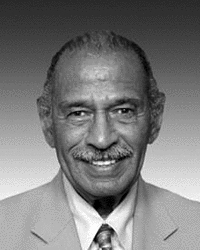
Rep. John Conyers (D-MI)

Rep. Conyers apparently understands that just because a law purports to fight something as evil (and, of course, politically unpopular) as child pornography doesn’t mean that the law’s actual implementation will be sound.

So when the wrong-to-be-righted is online piracy – i.e. SOPA – what is Conyers’ stance? He is one of its most vocal supporters:

The Internet has regrettably become a cash-cow for the criminals and organized crime cartels who profit from digital piracy and counterfeit products. Millions of American jobs are at stake because of these crimes.

Is it because Conyers is in the pocket of big media? Or that he hates the First Amendment? That’s not an easily apparent conclusion judging from his past votes and legislative history.

It’s of course possible that Conyers takes this particular stance on SOPA because SOPA, all things considered, happens to be a practical and fair law in the way that H.R. 1981 isn’t.

But a more cynical viewpoint is that Conyer’s technological understanding for one bill does not apply to the other. Everyone has been screwed over at some point by a massive, faceless database so it’s easy to be fearful of online databases – in fact, the less you know about computers, the more concerned you’ll be of the misuse of databases.

The technological issues underlying SOPA are arguably far more complex, though, and it’s not clear – as evidenced by Rep. Marino’s line of questioning – that Congressmembers, whether they support or oppose SOPA, have a full understanding of them.

As it stands though, SOPA had 31 cosponsors at its heyday. H.R. 1981 has 39. It will be interesting to see if this bill by Rep. Smith will face any residual backlash after what happened with SOPA.

SOPAopera.org – A hand-made list of SOPA / PROTECT-IP Congressional supporters and opponents

I’ve always been interested in exploring the various online Congressional information sources and the recent SOPA debate seemed like a good time to put some effort in it…also, I’ve always wanted to try out the excellent isotope Javascript library.

I had been passively paying attention to the debate and was surprised at how hard it was to find a list of supporters and opponents, given how much it’s dominated my (admittedly small bubblish) internet communities.

When I set out to compile the list, though, I could see why…the official government sites don’t make it easy to find or interpret the information. So SOPAopera is my game attempt at putting some basic information about it…the feedback I’ve gotten so far indicates that even constituents who have been reading a lot about SOPA/PROTECT-IP are surprised at the level and diversity of support the laws have among Congressmembers.

The Irrationality of Price Anchoring

Roulette wheel

Roulette wheel, by Conor Ogle from London, UK

tl;dr summary – people will unconsciously anchor their judgment on a random number given to them, even if that number was fabricated in front of their own eyes.

If you’ve never heard the term price anchor, you’ve undoubtedly experienced it anytime you’ve had to negotiate a purchase, whether it was for a used car, an online auction, or even cheap souvenirs at a Chinatown bazaar.

Even if you manage to haggle the seller down to half the initial stated price, don’t be too quick to congratulate yourself; the merchant might have gotten what he/she wanted despite the discount, if the asking price was over the top.

And the kicker is: even if you knew the initial asking price was too high, you still might have been fooled into overpaying.

Daniel Kahneman, a psychologist who won the Nobel Prize for Economics, conducted a famous experiment in which college students were influenced by a random number that they knew to be random:

Amos and I once rigged a wheel of fortune. It was marked from 0 to 100, but we had it built so that it would stop only at 10 or 65. We recruited students of the University of Oregon as participants in our experiment. One of us would stand in front of a small group, spin the wheel, and ask them to write down the number on which the wheel stopped, which of course was either 10 or 65.

We then asked them two questions:

  • Is the percentage of African nations among UN members larger or smaller than the number you just wrote?
  • What is your best guess of the percentage of African nations in the UN?

The spin of a wheel of fortune – even one that is not rigged – cannot possibly yield useful information about anything, and the participants in our experiment should simply have ignored it. But they did not ignore it. The average estimates of those who saw 10 and 65 were 25% and 45%, respectively.

Kahneman, Daniel (2011-10-25). Thinking, Fast and Slow (p. 120). Macmillan.

In his recently published book (well worth purchasing, BTW), Thinking, Fast and Slow, Kahneman reflects that “we were not the first to observe the effects of anchors, but our experiment was the first demonstration of its absurdity: people’s judgments were influenced by an obviously uninformative number.”

This lesson is something to keep in mind as a content-creator, particularly in a digital age in which it’s very easy to distribute your work for free. The fact that so many developers sell their apps for free (or, “freemium”) creates a price anchor that makes even 99 cents seem too much for a high-quality game (see Tom Oatmeal’s excellent comic on this phenomenon).

Kahneman’s experiment suggests that some people might be fooled into paying higher than they might, but in today’s inter-connected world where price comparisons are instant, it’s harder to get away with irrationally high prices. The more pressing concern is that pricing too low can cause customers to assign an irrationally low value to your product.

Rather than get offended when people demand that your product be free, see it as a quirk in human psychology – people can’t help but be fooled by even random numbers – and adjust accordingly. You may just have to adjust your product or its pitch to emphasize its uniqueness before you have the freedom to set a palatable price anchor.

Louis C.K. thanks his fans for buying his $5 Beacon Theater Show

Louis C.K. just sent an email to everyone who bought his recent Beacon Theater performance through his experimental sale. Here it is, just incase you haven’t forked over the measly $5 for a great hour of entertainment, and a significant milestone in online distribution:

Louis C.K. info@louisck.com via cmail4.com 11:44 AM (2 hours ago)

Hi. This is LOuie. It seriously is me. Im even going to leave the O stuipdly capatalized because who would pay an intern to do that?? Okay so you bought the thing with my fat face on it and you clicked the button that said i could email you. And i know that now you are thinking “aw shit. Why’d i let this guy into my life this way?”. Well dont worry. Because i really swear it that i wont bug you. I will not abuse this privalage of having your email. You wont hear from me again… Probably, unless i have something new to offer you. The reason i’m writing now, in the back of a car taking me to the Tonight Show set, is to let you know that as of now there is some new and cool stuff on my site, related to Live at the Beacon Theater. Theres a thing where you can download and print a dvd box cover and label so you can burn and make your own dvd of the video. And theres a new option where you can gift the special to as many people as you want (for 5 bucks each) and they’ll get a nice gifty email from you with a link to the video.

Also, some of you may know, i recently made a statement (that sounds so dumb. Like i’m the president or something) about how the video has been doing online. Im pasting it in here below in case you missed it.

Lastly I’m planning to put some more outtakes of the show on youtube and i think i will put one on the site that is only available for free to you folks on this list, who bought the thing and opted in. But dont hold me to that because really i just thought of it and typed it.

Okay well please have a happy rest of the year and more happy years after that. And please even have been happy in your past. What?

Thanks again for giving me 5 dollars. I bought 3 cokes with it.

Regards. Sincerely, Actually,

Louis

=========================== People of Earth (minus the ones who don’t give a shit about this): it’s been amazing to conduct this experiment with you. The experiment was: if I put out a brand new standup special at a drastically low price ($5) and make it as easy as possible to buy, download and enjoy, free of any restrictions, will everyone just go and steal it? Will they pay for it? And how much money can be made by an individual in this manner?

It’s been 4 days. A lot of people are asking me how it’s going. I’ve been hesitant to share the actual figures, because there’s power in exclusive ownership of information. What I didn’t expect when I started this was that people would not only take part in this experiment, they would be invested in it and it would be important to them. It’s been amazing to see people in large numbers advocating this idea. So I think it’s only fair that you get to know the results. Also, it’s just really cool and fun and I’m dying to tell everybody. I told my Mom, I told three friends, and that wasn’t nearly enough. So here it is.

First of all, this was a premium video production, shot with six cameras over two performances at the Beacon Theater, which is a high-priced elite Manhattan venue. I directed this video myself and the production of the video cost around $170,000. (This was largely paid for by the tickets bought by the audiences at both shows). The material in the video was developed over months on the road and has never been seen on my show (LOUIE) or on any other special. The risks were thus: every new generation of material I create is my income, it’s like a farmer’s annual crop. The time and effort on my part was far more than if I’d done it with a big company. If I’d done it with a big company, I would have a guarantee of a sizable fee, as opposed to this way, where I’m actually investing my own money.

The development of the website, which needed to be a very robust, reliable and carefully constructed website, was around $32,000. We worked for a number of weeks poring over the site to make sure every detail would give buyers a simple, optimal and humane experience for buying the video. I edited the video around the clock for the weeks between the show and the launch.

The show went on sale at noon on Saturday, December 10th. 12 hours later, we had over 50,000 purchases and had earned $250,000, breaking even on the cost of production and website. As of Today, we’ve sold over 110,000 copies for a total of over $500,000. Minus some money for PayPal charges etc, I have a profit around $200,000 (after taxes $75.58). This is less than I would have been paid by a large company to simply perform the show and let them sell it to you, but they would have charged you about $20 for the video. They would have given you an encrypted and regionally restricted video of limited value, and they would have owned your private information for their own use. They would have withheld international availability indefinitely. This way, you only paid $5, you can use the video any way you want, and you can watch it in Dublin, whatever the city is in Belgium, or Dubai. I got paid nice, and I still own the video (as do you). You never have to join anything, and you never have to hear from us again.

I really hope people keep buying it a lot, so I can have shitloads of money, but at this point I think we can safely say that the experiment really worked. If anybody stole it, it wasn’t many of you. Pretty much everybody bought it. And so now we all get to know that about people and stuff. I’m really glad I put this out here this way and I’ll certainly do it again. If the trend continues with sales on this video, my goal is that i can reach the point where when I sell anything, be it videos, CDs or tickets to my tours, I’ll do it here and I’ll continue to follow the model of keeping my price as far down as possible, not overmarketing to you, keeping as few people between you and me as possible in the transaction. (Of course i reserve the right to go back on all of this and sign a massive deal with a company that pays me fat coin and charges you straight up the ass.). (This is you: yes Louie. And we’ll all enjoy torrenting that content. You fat sweaty dolt).

I probably sound kind of crazy right now. It’s been a really fun and intense few days. This video was paid for by people who bought tickets, and then bought by people who wanted to see that same show. I got to do exactly the show I wanted, and exactly the show you wanted.

I also got an education. And everything i learned are things i was happy to learn. I learned that people are interested in what happens and shit (i didn’t go to college)

I learned that money can be a lot of things. It can be something that is hoarded, fought over, protected, stolen and withheld. Or it can be like an energy, fueled by the desire, will, creative interest, need to laugh, of large groups of people. And it can be shuffled and pushed around and pooled together to fuel a common interest, jokes about garbage, penises and parenthood.

I want to thank Blair Breard who produced this video and produces my series LOUIE, and I want to thank Caspar and Giles at Version Industries, who created the website.

I hope with all of my heart that I stay funny. Otherwise this all goes to hell. Please have a safe and happy holiday, and thank you again for all this crazy shit.

Sincerely, Louis C.K.

To me, there’s no comedian out there right now who is as inspiring as Louis. He shoots his own TV show and edits it on his own laptop. When a fan uploads a bootleg recording of him on a torrent site, he emails the fan personally to ask to take it down; not because he thinks it’s theft, but because he doesn’t want he sees as his rough draft work to be floating around. And then to try to one-up the torrenters, he experiments with distributing his own show.

I don’t begrudge people who have made and positioned their careers around the traditional media model (including newspapers and music, of course). I grew up with computers and it still took me by surprise. I don’t know what Louis’s background, but judging by the caliber of his comedy, he seems to have been too busy paying his dues in the comedy club circuit to have become a formally trained multi-media artist/videographer/techie/marketer. And yet even though he’s in his mid-40s and could likely coast on his career, he’s undertaken the kind of sacrifice and experimentation that you rarely see among artists and creators who have a much greater need to figure out the digital transition.

And he’s pretty funny. And, if it’s not already unfair that he’s got so much going for him, he’s incredibly eloquent and insightful even when doing serious interviews. Check out this interview with him on Fresh Air:

So I got a lot of emails from people saying, ‘Why can’t you just keep it clean? Because I am now shut off from your act by the horrible things you said, and that’s such a shame.’ And I would not usually respond to them because I don’t return emails, but in my head and to a few of them I said, ‘Well, you’re the one putting the limit. Not me. I’m saying a bunch of stuff, and you’re the one saying I should only say one facet of it.’ That’s a limit. But at the same time, when these people would write to me I’d kind of like them. Whenever I’ve encountered a Christian saying, ‘Why don’t you stop talking like that so I can hear you?’ I think, ‘Well you’re the one putting the earmuffs on, but I wish you could hear me because I like you.’


“There are things in the show I’m able to show [my daughters]. There’s an episode about Halloween that I showed them parts of. There’s a lot of things they’re able to see. They’re just fun stories. And my daughters, I think they really enjoy what I do. There are certainly some things they can’t see in Louie because … the language is grown-up and is for adults. They know that. They get it. I’ve played them some George Carlin clips that have cursing in them. I explain it to my kids that some people get uncomfortable or their feelings get hurt by certain words, so you want to respect that in regular life, but there is a reason for these words. They’re not just ‘bad.’ So I’m bringing them along. They’ll see this stuff when it’s appropriate to see it.”

I was one of the lucky people who got $10 tickets to his show in Brooklyn a few months back. So many people rushed to get tickets online that the ticketseller’s site crashed. Later in the day, Louis announced that he would stick around for a third show. What a class act.

To find insights: ask the cage cleaners, not the veterinarians

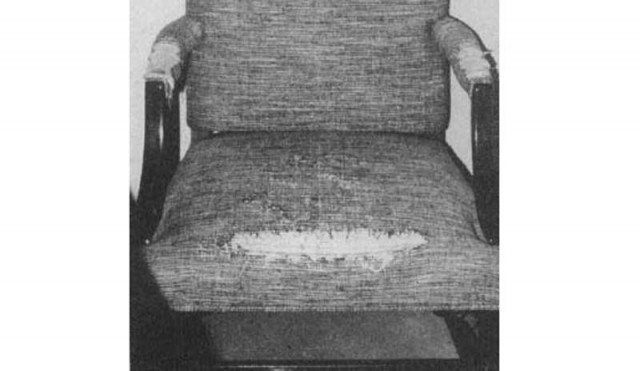
A chair with its front worn out.

A chair with its front worn out: image cropped from Sapolsky's book, Why Zebras Don't Get Ulcers, Third Edition

Sometimes the great insights about how things really work can come from the people who are thought to be too far down the ladder to possibly understand the big picture. Robert M. Sapolsky, an author and professor of neurology at Stanford, coined a proverb for this phenomenon:

“If you want to know if the elephant at the zoo has a stomachache, don’t ask the veterinarian, ask the cage cleaner.”

In other words, the low-level employees who fix what’s broken may often be in the best position to first notice when, why, and how something broke. Or, as Sapolsky puts it: “People who clean up messes become attuned to circumstances that change the amount of mess there is.”

This is not just a cute aphorism to remind you to tip your cleaning lady, but a lesson that has manifested itself at least a few times in scientific history. Sapolsky retells the confession of Dr. Meyer Friedman, who – with his partner R. H. Rosenman – is credited with discovering the link between Type-A personalities and heart disease. This revelation sparked off the field of research into how physical and mental health are intertwined.

According to Friedman, though, the breakthrough observation first came from his upholsterer:

It was the mid-1950s, Friedman and Rosenman had their successful cardiology practice, and they were having an unexpected problem. They were spending a fortune having to reupholster the chairs in their waiting rooms. This is not the sort of issue that would demand a cardiologist’s attention. Nonetheless, there seemed to be no end of chairs that had to be fixed. One day, a new upholsterer came in to see to the problem, took one look at the chairs, and discovered the Type A-cardiovascular disease link.

“What the hell is wrong with your patients? People don’t wear out chairs this way.” It was only the front-most few inches of the seat cushion and of the padded armrests that were torn to shreds, as if some very short beavers spent each night in the office craning their necks to savage the fronts of the chairs. The patients in the waiting rooms all habitually sat on the edges of their seats, fidgeting, clawing away at the armrests.

The rest should have been history: up-swelling of music as the upholsterer is seized by the arms and held in a penetrating gaze—“Good heavens, man, do you realize what you’ve just said?” Hurried conferences between the upholsterer and other cardiologists. Frenzied sleepless nights as teams of idealistic young upholsterers spread across the land, carrying the news of their discovery back to Upholstery/Cardiology Headquarters—“Nope, you don’t see that wear pattern in the waiting-room chairs of the urologists, or the neurologists, or the oncologists, or the podiatrists, just the cardiologists. There’s something different about people who wind up with heart disease”—and the field of Type-A therapy takes off.

Sapolsky, Robert M. Why Zebras Don’t Get Ulcers, Third Edition: The Acclaimed Guide to Stress, Stress-Related Diseases, and Coping (p. 408). Macmillan.

Unfortunately for the upholsterer, Dr. Friedman was too busy to listen to him. Only years later, when Friedman and Rosenman conducted studies of their patients did Friedman finally grasp the importance of what his upholsterer had discovered (although not the upholsterer’s name).

It’s hard to know how many other “Eureka, the janitor is right!” moments that science and technology are beholden to. Unlike the case of Sir Alexander Fleming, it’s one thing to say how, out of genius and keen observation, you made lemonade out of lemons (in Fleming’s case, penicillin after forgetting to put away his staph samples during summer vacation). It’s a little more deflating to admit that the maintenance worker beat you to the discovery.

Cleaning up the mess in online advertising

Eric Veach, who author Steven Levy describes as the “Google engineer who created the most successful ad system in history,” was no mere low-level grunt when he designed the implementation for AdWords (although apparently, this accomplishment isn’t enough to inspire someone to write a Wikipedia entry on him). He came to Google in 2000 after working on Pixar’s movie-rendering software and was assigned to the ad department, which Veach describes to Levy as “a backwater of the company.” (Levy, Steven (2011-04-12). In The Plex p. 83.)

At that time, Google ads were still sold by actual people and Google had declined an offer to merge with Overture Services, then the leader in auction-bid online advertising and later acquired by Yahoo. So Veach was part of the team to create Google’s own auction system. Veach had observed – and strongly disliked – how Overture’s system invited a kind of “cat-and-mouse game” between bidders: If the winning bidder bid $100, it would have to pay $100, even if the next bidder had only bid $50. The optimal strategy, of course, was to bid the lowest increment possible to edge out the other bidders, which led to the use of automated software to game the system.

This was not an ideal competitive situation. And, according to other reports, Veach and Salar Kamangar were dismayed at its impact on server load, since advertisers would frequently log in to make these minor bid modifications. To clean up this mess, Veach designed a different model. As Levy describes it:

The winner of the auction wouldn’t be charged for the amount of his victorious bid but instead would pay a penny more than the runner-up bid. (Example: If Joe bids 10 cents a click, Alice bids 6, and Sue bids 2, Joe wins the top slot and pays 7. Alice is in the next slot, paying 3.) It was incredibly liberating because it eliminated the fear of “winner’s remorse,” where the high bidder in an auction feels suckered by paying too much.

Levy, Steven (2011-04-12). In The Plex (p. 90). Simon & Schuster, Inc.. Kindle Edition.

Veach’s model was so counter-intuitive that he had to constantly defend it, even to Larry Page and Sergey Brin. He was vindicated when AdWords (which had several other technical innovations behind it) went on to help Google to its first profitable year in 2002.

As Levy writes, Veach’s method had already been vouched for, in high places:

Part of her [Sheryl Sandberg, former chief of staff to the secretary of the treasury in the Clinton administration] job at Google was explaining its innovative auction. She kept staring at the formula, wondering why it seemed so familiar. So she called her former boss, Treasury Secretary Larry Summers. “Larry, we have this problem,” she said. “I’m trying to explain how our auction works—it seems familiar to me.” She described it to him. “Oh yeah,” said Summers. “That’s a Vickery second-bid auction!” He explained that not only was this a technique used by the government to sell Federal Reserve bonds but the economist who had devised it had won a Nobel Prize.

Veach had reinvented it from scratch.

Levy, Steven (2011-04-12). In The Plex (p. 90). Simon & Schuster, Inc.

While Veach was not some low-level “cage cleaner,” his job did involve cleaning up a seedy part in the world of online advertising. Levy’s book may gloss over whatever mathematical proofs and logic Veach used in deciding on the second-bid auction method. But given that Veach’s strategy was initially doubted by Google’s founders, who themselves were not shy to contrarian thinking, Veach is a good example of how those who get their hands dirty may end up with a clearer “big picture” of how a system truly works.

The pre-mortem

The case of Friedman’s upholsterer is by definition, a rare occurrence. A more common – and tragically so – kind of cage-cleaner is the whistleblower.

Dr. Richard Feynman, the Nobel Prize-winning quantum physicist, might be best remembered by the general public for his role in the investigation of the Challenger disaster. During a televised press conference, Feynman used a cup of ice water to demonstrate how NASA’s managers apparently overlooked a simple tenet of physics that helped lead to the shuttle explosion:

But as Dr. Feynman tells in the second half of his book, What Do You Care What Other People Think? (which should be required reading for all scientists, engineers, and journalists), he may have gotten credit for the revelation of the shuttle’s O-ring, but he did not come up with it himself. One of his fellow commission members pointed out the possible defect to him. And that commission member had been told about it by an anonymous astronaut, who said that NASA had data demonstrating the O-ring’s problem but apparently hadn’t used it.

The truism that “Hindsight is 20/20″ is sometimes used to excuse the most boneheaded of screw-ups. It’s not that it took the Challenger to blow up before we could discover that the O-rings, like most other solids in existence, lose resilience when it’s cold out. High-level managers had the information available to them; they just chose to overlook the complaints and observations of low-level engineers. The good-natured Feynman was so alarmed by NASA’s “fantastic faith in the machinery” that he threatened to quit the investigation unless they included his criticisms in the final report.

But anyone who works in an organization of more than 2 people can attest to how fear of being ostracized can make it difficult to stop a project or plan in motion. During a Let’s-Go!-type of team meeting, there’s nothing more of a buzz-kill than someone in the back constantly complaining how the i’s aren’t all properly dotted.

In his book “Thinking, Fast and Slow,” psychologist Daniel Kahneman (a Nobel Prize winner himself) describes how psychologist Gary Klein devised a sort of “partial remedy” that I had never heard of before – but that I wish were more commonplace: the “premortem“:

The procedure is simple: when the organization has almost come to an important decision but has not formally committed itself, Klein proposes gathering for a brief session a group of individuals who are knowledgeable about the decision. The premise of the session is a short speech: “Imagine that we are a year into the future. We implemented the plan as it now exists. The outcome was a disaster. Please take 5 to 10 minutes to write a brief history of that disaster.”

The premortem has two main advantages: it overcomes the groupthink that affects many teams once a decision appears to have been made, and it unleashes the imagination of knowledgeable individuals in a much-needed direction. As a team converges on a decision—and especially when the leader tips her hand—public doubts about the wisdom of the planned move are gradually suppressed and eventually come to be treated as evidence of flawed loyalty to the team and its leaders. The suppression of doubt contributes to overconfidence in a group where only supporters of the decision have a voice. The main virtue of the premortem is that it legitimizes doubts. Furthermore, it encourages even supporters of the decision to search for possible threats that they had not considered earlier.

Kahneman, Daniel (2011-10-25). Thinking, Fast and Slow (pp. 264-266). Macmillan.

Just like the egotistical scientist who is loathe to give credit to a janitor for first making a groundbreaking observation, no project manager likes admitting that disaster was averted only through the foresight of an underling. The problem is such that in bureaucracies, managers may actively avoid receiving such momentum-killing feedback, and underlings who wish to keep their jobs may lean toward keeping quiet rather than being pegged as the negative nancy.

The pre-mortem, which (ideally) rewards contributors for thinking destructively, may be one of the few ways to recognize the cage-cleaners who deal with the muck. Or at least, the people who take the time to listen to them.

The Bastards Book: A Programming Tutorial for journalists, researchers, analysts, and anyone else who cares about data

Crossing Bleecker and Lafayette through a snowstorm

Back when I wrote my “Coding for Journalists 101″ guide about a year and a half ago, I barely realized how useful code could be as a journalistic tool. Since then, after the Dollars for Docs project at ProPublica and various other programming adventures, I’ve become a slightly better coder and even more adamant that programming is basically a necessity for anyone who cares about understanding and communicating about the world in a quantitative, meaningful way.

The world of data has exploded in the past few years without a corresponding increase in the people or tools to efficiently make sense of it. And so I’ve had a hankering to create a more cohesive, useful programming guide aimed at not just journalists, but for anyone in any field.

It’s called the Bastards Book of Ruby. It’s not really just about Ruby and “bastards” was a working title that I came up with but never got around to changing. But it seems to work for now.

As I was writing the introduction (“Programming is for Anyone“), I came across this Steve Jobs interview with Fresh Air. He says pretty much exactly what I’m thinking, but he said it 15 years ago — surprising given that the Web was in its infancy and Jobs’s fame was largely out of making computers brain-dead simple for people. He wasn’t much of a programmer, but he really was a genius at understanding the bigger picture of what he himself only dabbled in:

“In my perspective … science and computer science is a liberal art, it’s something everyone should know how to use, at least, and harness in their life. It’s not something that should be relegated to 5 percent of the population over in the corner. It’s something that everybody should be exposed to and everyone should have mastery of to some extent, and that’s how we viewed computation and these computation devices.”

Bastards Book of Ruby. It’s just a rough draft but already numbers at 75,000 words. See the table of contents.

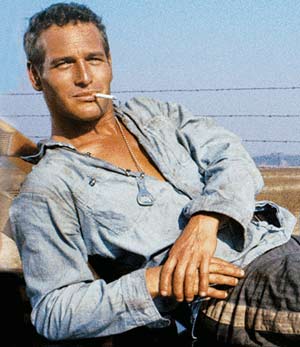
Paul Newman, Scrappy Startup Entrepreneur

coolhandluke

"Sometimes nothin' can be a real cool hand."

After watching Paul Newman in “The Hustler” on Netflix this weekend – and then reading the spectacular details of his life (according to Wikipedia) – I decided to buy his book that tells the origins of his “Newman’s Own” food brand. I know that the Newman O’s mint cookies are the best in the market and I knew vaguely that it donated to charity (about $300 million; all of its after-tax profits, since the company’s start), but didn’t really know there was much of a story behind it. After all, he’s Paul Newman. He could put his name on cowpies and they’d sell, right?

However, according to the book, Newman and his partner, author A. E. Hotchner, faced all of the challenges of a modern day startup (except perhaps, having to put their whole lives/assets on the line; Newman was still a busy actor into his last years). Early on in the book, they describe having a meeting with “the largest marketing company in America.” Despite Newman’s name recognition, the marketing executive informs him that “Just because they liked you as Butch Cassidy doesn’t mean they’ll like your salad dressing.”

Newman and Hotchner are told that the marketing alone – which includes focus groups, promotion, distribution and public relations – would cost more than $1 million. Newman and Hotchner leave the meeting and decide to launch their salad-dressing company with just $40,4000.

The origin story of Newman’s Own ends up sharing some traits common among today’s Internet-age startups:

Thinking you can do it better than the big guys:

Over the years, even in four-star restaurants, PL had been rejecting the house dressings and concocting his own….On one occasion, when the restaurant mistakenly served the salad with its own dressing, Paul took the salad to the men’s room, washed off the dressing, dried it with paper towels, and, after returning to the table, anointed it with his own, which he concocted with ingredients brought to him from the kitchen

Having previous entrepreneurial experience

When Paul was in college, he had demonstrated a knack for getting a business invention to fly. He was attending Kenyon College in Gambier, Ohio, when, to augment his dwindling GI Bill funds, he went into the laundry business. The school’s laundry company used to visit the dorms, going from room to room to pick up individual laundry; then Paul made a deal with the company for a much lower rate to pick up the laundry at one site in the town.

Paul rented an abandoned storefront in a partially developed part of Gambier…and advertised in the school paper that his laundry service would serve free beer to any customer bringing in his laundry. Figuring the cost of a keg of beer, plus rent and the laundry’s charges, against what he charged for the laundry, Paul was able to turn a profit of $80 a week, which by today’s conversion amounts to about $500.

Paul finally sold the business in his senior year to a friend of his, but as luck would have it, a month or so later one of the customers who had overimbibed the free beer put on a boxing glove, staggered out into the street, and started to masturbate a horse that was tied up there. The authorities shut down the business, busting the whole shop

Using a ping-pong table as a desk

So instead of buying office furniture, Paul decided that since it was September and he was closing his swimming pool, he would simply furnish the office with his pool furniture, even to the extent of keeping a beach umbrella over our shared desk (his picnic table).

Paul’s Ping-Pong table became our conference table, but the only conferences we held were when we played Ping-Pong. Paul wrote our scores on the low ceiling, but when his losses mounted significantly, he had the ceiling painted.

Staying true to the vision, damn the reality

Newman’s and Hotchner’s were both appalled by the amount of preservatives found in supermarket dressings. They were determined to use a recipe that contained only fresh ingredients, not thinking how that would make production and storage difficult:

We did not have EDTA (ethylenediaminetetraaceticacid) in our formula, which was thought to be essential in preserving life span on the shelf. “If a bottled dressing cannot stay on the shelf for somewhere in the neighborhood of a year,” Andy explained, “it will not be acceptable to the supermarkets.

All those big outfits have chemists who’ve been using these fixes for as long as I’ve been in business. The food business is a very practicalaffair—whatever you put in a bottle has to have shelf life or forget it. Let’s try half of the usual EDTA. What about it?”

We didn’t budge.

All-natural meant positively no chemicals. Andy’s chemists gave him a hard time about it, but eventually they put our formula through the longevity test. The result was not what they expected. They found that in the process of making mustard, in grinding the whole mustard seed, a layer of mucus is released that is a natural gum and did everything that EDTA did, but did it naturally.

The company leader eating his own dog food

People would say to me, ‘Is Newman really involved in this thing?’ and they were surprised to hear that no product ever goes out unless he personally eats it, and if he doesn’t like it, it’s not going anyplace. Hotchner and Newman were hands-on about everything. They wrote the legends, they tinkered with the label, they were thoroughly involved

And:

Mr. Newman went on: “Some people have sexual dreams, but I dream about food. Then when I wake up I want to eat the food I dreamed about. That means I have to keep a big pantry, because you never know.

Facing rules that favored entrenched competitors

In the course of churning out new products, we came perilously close to putting ourselves out of business because we hadn’t taken into account a new phenomenon in the food business, a diabolical supermarket invention—slotting…slotting involved actual cash payments of $28,000–$30,000 to each store for the privilege of displaying a new product, and there was no guarantee as to how long a store would keep it on the shelf.

Of course, there are unrepeatable aspects of Newman’s business that just won’t apply to most other startups, mainly a) He’s Paul Newman and b) all of the company’s profits go to charity. But this book is a fast and fun read. It helps that Newman is one of the few (living or dead) uber-celebrities who, the more you find out about him, the more you love him.

The book is called “Shameless Exploitation in Pursuit of the Common Good: The Madcap Business Adventure by the Truly Oddest Couple” and is authored by Newman and Hotchner and published by Random House (2003). (Amazon / Google Books)

Tim Hetherington’s Last Libya Photos, at the Bronx Doc Center

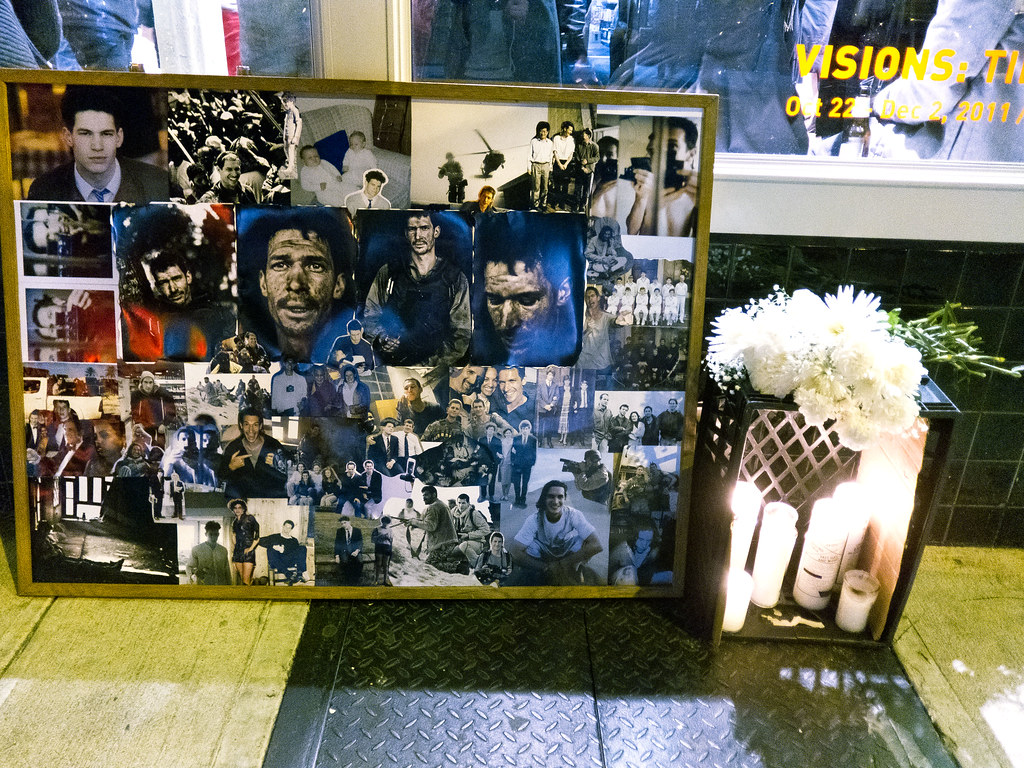
Memorial to Tim Hetherington

Last weekend, the newly-built Bronx Documentary Center opened with an exhibition of fallen war photographer Tim Hetherington’s final photos. Hetherington was killed in Libya on Apr. 20, 2011, after Gadaffi forces shelled his position. Photographer Chris Hondros also died in the attack.

Two of my favorite of Hetherington’s final photos, from the city of Misurata, Apr. 19 and 20:

Tim Hetherington's Misurata, Libya photos, at the Bronx Doc Center

Before his death, Hetherington and his friend, Michael Kamber, a photojournalist with the New York Times, had shared a dream to build a gallery in the Bronx to further the teaching of photojournalism and documentary work in the city. Kamber continued with that vision after Hetherington’s death, and the Bronx Doc Center is the result of his and many others’ hard work and generosity.

Bronx Documentary Center, Tim Hetherington Exhibition

Kamber wrote a piece for the NYT Lens blog

More than any journalist I know, Tim was conceptual in his work. He thought about the big ideas behind an event, the dynamics, history and driving forces. He then tailored his photography and multimedia work accordingly, trying to dig through and expose these forces. His methods stood in stark contrast to many of us who photograph what fate and others present to us, unwittingly allowing the narrative to be shaped through our acquiescence.

In an astonishingly wide-ranging oeuvre that ran from photo books to articles and film to personal videos, Tim smashed boundaries and enlarged our understanding of what a documentarian and journalist could be.

Michael Kamber:

Michael Kamber, Bronx Doc Center's exhibition of Tim Hetherington

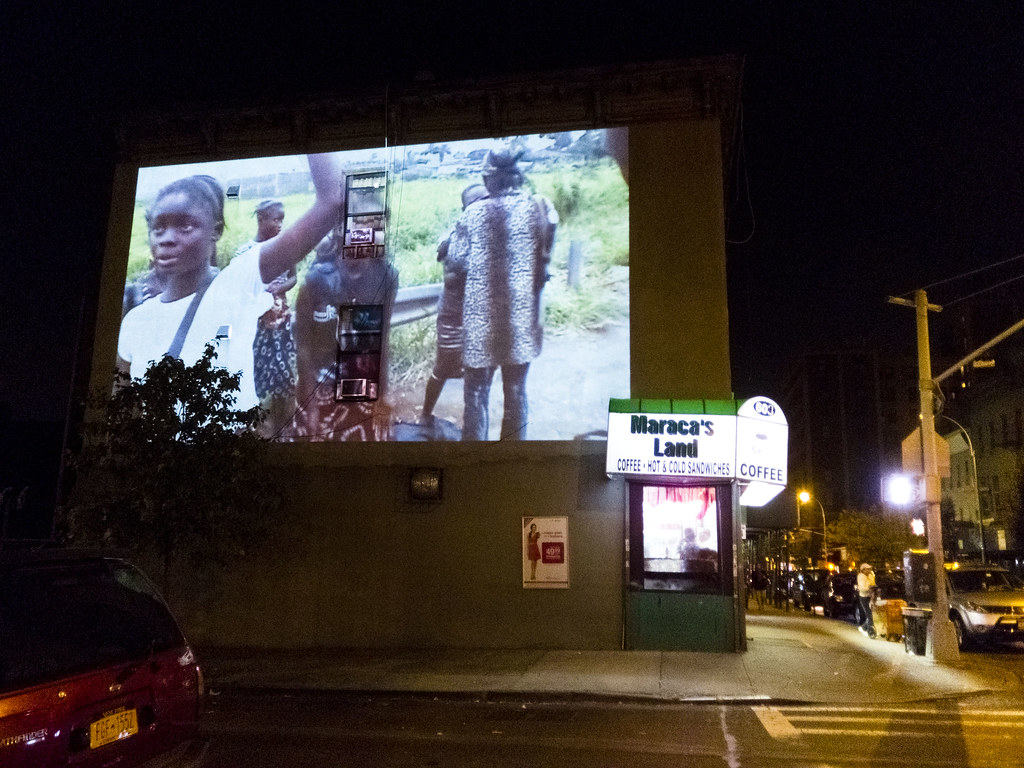
One of Hetherington’s documentaries, “Diary,” was projected against the side of a neighboring building:

Hetherington's doc, "Diary", shown on a Bronx building

Kamber’s tribute to Hetherington in the NYT also includes the kind of praise that every photojournalist hopes to receive in his or her lifetime:

Tim began planning his return to Libya. He combed through his images to find something — some concept that stood apart from the thousands of images the other photojournalists were putting out from Benghazi and Ajdabiya.

He was upset at how some photographers presented the rag-tag rebels as heroic fighters, when in fact they were sometimes “kind of a joke.” Those pictures, he said, might win prizes, but not his respect.

“We have to fight making propaganda,” he said to me one night at dinner. “The media has become such a part of the war machine now that we all have to be conscious of it more than ever before. ”

You can follow the Bronx Doc center’s Tumblr here. The BDC is located on 614 Courtlandt Avenue and 151st street in the South Bronx and is open Wednesday-Sunday, 11AM – 6PM.

Hetherington’s last photo, dated April 20, 2011, in the city of Misurata:

Tim Hetherington, Bronx Documentary Center

Steve Jobs, 1955-2011

(I love that the filename for this Steve Jobs photo on apple.com is: http://images.apple.com/home/images/t_hero.png)

It’s hard to believe that we’ll ever see such a passionate and imaginative inventor in this generation again. R.I.P. Steve.

His 2005 commencement speech to Stanford:

I am honored to be with you today at your commencement from one of the finest universities in the world. I never graduated from college. Truth be told, this is the closest I’ve ever gotten to a college graduation. Today I want to tell you three stories from my life. That’s it. No big deal. Just three stories.

The first story is about connecting the dots.

I dropped out of Reed College after the first 6 months, but then stayed around as a drop-in for another 18 months or so before I really quit. So why did I drop out?

It started before I was born. My biological mother was a young, unwed college graduate student, and she decided to put me up for adoption. She felt very strongly that I should be adopted by college graduates, so everything was all set for me to be adopted at birth by a lawyer and his wife. Except that when I popped out they decided at the last minute that they really wanted a girl. So my parents, who were on a waiting list, got a call in the middle of the night asking: “We have an unexpected baby boy; do you want him?” They said: “Of course.” My biological mother later found out that my mother had never graduated from college and that my father had never graduated from high school. She refused to sign the final adoption papers. She only relented a few months later when my parents promised that I would someday go to college.

And 17 years later I did go to college. But I naively chose a college that was almost as expensive as Stanford, and all of my working-class parents’ savings were being spent on my college tuition. After six months, I couldn’t see the value in it. I had no idea what I wanted to do with my life and no idea how college was going to help me figure it out. And here I was spending all of the money my parents had saved their entire life. So I decided to drop out and trust that it would all work out OK. It was pretty scary at the time, but looking back it was one of the best decisions I ever made. The minute I dropped out I could stop taking the required classes that didn’t interest me, and begin dropping in on the ones that looked interesting.

It wasn’t all romantic. I didn’t have a dorm room, so I slept on the floor in friends’ rooms, I returned coke bottles for the 5¢ deposits to buy food with, and I would walk the 7 miles across town every Sunday night to get one good meal a week at the Hare Krishna temple. I loved it. And much of what I stumbled into by following my curiosity and intuition turned out to be priceless later on. Let me give you one example:

Reed College at that time offered perhaps the best calligraphy instruction in the country. Throughout the campus every poster, every label on every drawer, was beautifully hand calligraphed. Because I had dropped out and didn’t have to take the normal classes, I decided to take a calligraphy class to learn how to do this. I learned about serif and san serif typefaces, about varying the amount of space between different letter combinations, about what makes great typography great. It was beautiful, historical, artistically subtle in a way that science can’t capture, and I found it fascinating.

None of this had even a hope of any practical application in my life. But ten years later, when we were designing the first Macintosh computer, it all came back to me. And we designed it all into the Mac. It was the first computer with beautiful typography. If I had never dropped in on that single course in college, the Mac would have never had multiple typefaces or proportionally spaced fonts. And since Windows just copied the Mac, it’s likely that no personal computer would have them. If I had never dropped out, I would have never dropped in on this calligraphy class, and personal computers might not have the wonderful typography that they do. Of course it was impossible to connect the dots looking forward when I was in college. But it was very, very clear looking backwards ten years later.

Again, you can’t connect the dots looking forward; you can only connect them looking backwards. So you have to trust that the dots will somehow connect in your future. You have to trust in something — your gut, destiny, life, karma, whatever. This approach has never let me down, and it has made all the difference in my life.

My second story is about love and loss.

I was lucky — I found what I loved to do early in life. Woz and I started Apple in my parents garage when I was 20. We worked hard, and in 10 years Apple had grown from just the two of us in a garage into a $2 billion company with over 4000 employees. We had just released our finest creation — the Macintosh — a year earlier, and I had just turned 30. And then I got fired. How can you get fired from a company you started? Well, as Apple grew we hired someone who I thought was very talented to run the company with me, and for the first year or so things went well. But then our visions of the future began to diverge and eventually we had a falling out. When we did, our Board of Directors sided with him. So at 30 I was out. And very publicly out. What had been the focus of my entire adult life was gone, and it was devastating.

I really didn’t know what to do for a few months. I felt that I had let the previous generation of entrepreneurs down – that I had dropped the baton as it was being passed to me. I met with David Packard and Bob Noyce and tried to apologize for screwing up so badly. I was a very public failure, and I even thought about running away from the valley. But something slowly began to dawn on me — I still loved what I did. The turn of events at Apple had not changed that one bit. I had been rejected, but I was still in love. And so I decided to start over.

I didn’t see it then, but it turned out that getting fired from Apple was the best thing that could have ever happened to me. The heaviness of being successful was replaced by the lightness of being a beginner again, less sure about everything. It freed me to enter one of the most creative periods of my life.

During the next five years, I started a company named NeXT, another company named Pixar, and fell in love with an amazing woman who would become my wife. Pixar went on to create the worlds first computer animated feature film, Toy Story, and is now the most successful animation studio in the world. In a remarkable turn of events, Apple bought NeXT, I returned to Apple, and the technology we developed at NeXT is at the heart of Apple’s current renaissance. And Laurene and I have a wonderful family together.

I’m pretty sure none of this would have happened if I hadn’t been fired from Apple. It was awful tasting medicine, but I guess the patient needed it. Sometimes life hits you in the head with a brick. Don’t lose faith. I’m convinced that the only thing that kept me going was that I loved what I did. You’ve got to find what you love. And that is as true for your work as it is for your lovers. Your work is going to fill a large part of your life, and the only way to be truly satisfied is to do what you believe is great work. And the only way to do great work is to love what you do. If you haven’t found it yet, keep looking. Don’t settle. As with all matters of the heart, you’ll know when you find it. And, like any great relationship, it just gets better and better as the years roll on. So keep looking until you find it. Don’t settle.

My third story is about death.

When I was 17, I read a quote that went something like: “If you live each day as if it was your last, someday you’ll most certainly be right.” It made an impression on me, and since then, for the past 33 years, I have looked in the mirror every morning and asked myself: “If today were the last day of my life, would I want to do what I am about to do today?” And whenever the answer has been “No” for too many days in a row, I know I need to change something.

Remembering that I’ll be dead soon is the most important tool I’ve ever encountered to help me make the big choices in life. Because almost everything — all external expectations, all pride, all fear of embarrassment or failure – these things just fall away in the face of death, leaving only what is truly important. Remembering that you are going to die is the best way I know to avoid the trap of thinking you have something to lose. You are already naked. There is no reason not to follow your heart.

About a year ago I was diagnosed with cancer. I had a scan at 7:30 in the morning, and it clearly showed a tumor on my pancreas. I didn’t even know what a pancreas was. The doctors told me this was almost certainly a type of cancer that is incurable, and that I should expect to live no longer than three to six months. My doctor advised me to go home and get my affairs in order, which is doctor’s code for prepare to die. It means to try to tell your kids everything you thought you’d have the next 10 years to tell them in just a few months. It means to make sure everything is buttoned up so that it will be as easy as possible for your family. It means to say your goodbyes.

I lived with that diagnosis all day. Later that evening I had a biopsy, where they stuck an endoscope down my throat, through my stomach and into my intestines, put a needle into my pancreas and got a few cells from the tumor. I was sedated, but my wife, who was there, told me that when they viewed the cells under a microscope the doctors started crying because it turned out to be a very rare form of pancreatic cancer that is curable with surgery. I had the surgery and I’m fine now.

This was the closest I’ve been to facing death, and I hope it’s the closest I get for a few more decades. Having lived through it, I can now say this to you with a bit more certainty than when death was a useful but purely intellectual concept:

No one wants to die. Even people who want to go to heaven don’t want to die to get there. And yet death is the destination we all share. No one has ever escaped it. And that is as it should be, because Death is very likely the single best invention of Life. It is Life’s change agent. It clears out the old to make way for the new. Right now the new is you, but someday not too long from now, you will gradually become the old and be cleared away. Sorry to be so dramatic, but it is quite true.

Your time is limited, so don’t waste it living someone else’s life. Don’t be trapped by dogma — which is living with the results of other people’s thinking. Don’t let the noise of others’ opinions drown out your own inner voice. And most important, have the courage to follow your heart and intuition. They somehow already know what you truly want to become. Everything else is secondary.

When I was young, there was an amazing publication called The Whole Earth Catalog, which was one of the bibles of my generation. It was created by a fellow named Stewart Brand not far from here in Menlo Park, and he brought it to life with his poetic touch. This was in the late 1960’s, before personal computers and desktop publishing, so it was all made with typewriters, scissors, and polaroid cameras. It was sort of like Google in paperback form, 35 years before Google came along: it was idealistic, and overflowing with neat tools and great notions.

Stewart and his team put out several issues of The Whole Earth Catalog, and then when it had run its course, they put out a final issue. It was the mid-1970s, and I was your age. On the back cover of their final issue was a photograph of an early morning country road, the kind you might find yourself hitchhiking on if you were so adventurous. Beneath it were the words: “Stay Hungry. Stay Foolish.” It was their farewell message as they signed off. Stay Hungry. Stay Foolish. And I have always wished that for myself. And now, as you graduate to begin anew, I wish that for you.

Stay Hungry. Stay Foolish.

Thank you all very much.