Category Archives: thoughts

Thoughts, musings, etc.

The banality of Godliness: The Vatican and Sex Scandals and a Slow Mail System

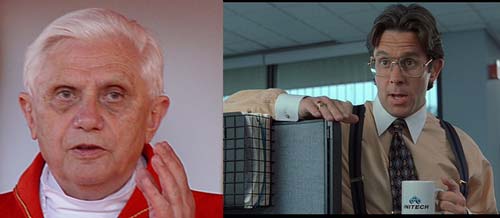
Ahhh, yeahhhh...Did you get the memo?

Ahhh, yeahhhh...Did you get the memo?

Ross Douthat, the cherubic Catholic on the NYT’s column head, tries to take a stab at his church and its recent spate of sex scandal revelations:

There has been some accountability for the abusers, but not nearly enough for the bishops who enabled them. And now the shadow of past sins threatens to engulf this papacy.

Popes do not resign. But a pope can clean house. And a pope can show contrition, on his own behalf and on behalf of an entire generation of bishops, for what was done and left undone in one of Catholicism’s darkest eras.

This is Holy Week, when the first pope, Peter, broke faith with Christ and wept for shame. There is no better time for repentance.

Douthat is rightfully taking flak from commenters for trying to blame some of the scandal on the “silly season of the ’70s”, as if disco clubs and second-wave feminism were gateways for priests to molest boys in the confessional (as one commenter points out, the moral progressivism of the 70s, which presumably weakened the Church’s influence, may have helped give victims an opening to speak out).

But if I were to be the devil’s advocate, I’d point out this passage in Douthat’s column as one to raise doubts about the holiness of the Catholic church:

There are two charges against Benedict XVI: first, that he allowed a pedophile priest to return to ministry while archbishop of Munich in 1980; and second, that as head of the Vatican’s Congregation for the Doctrine of the Faith in the 1990s, he failed to defrock a Wisconsin priest who had abused deaf children 30 years before.

The second charge seems unfair. The case was finally forwarded to the Vatican by the archbishop of Milwaukee, Rembert Weakland, more than 20 years after the last allegation of abuse.

One of the supposed upsides of having a papacy is that the Pope is presumably the supreme decider, as direct a link to God’s authority as we can have on earth. He definitively settles doctrinal and moral matters, and his words and his mind are pretty much in tune with God’s, and no one who believes in the supremacy of the Catholic Church should have any doubt otherwise.

So, basically, one of Douthat’s (and the official Vatican spokesperson’s) defenses is that, well, the man who was destined to be God’s infallible voice, didn’t stop a man (Father Murphy in Wisconsin) from molesting 200 deaf boys because the relevant memo didn’t get to him (or to the Pope at the time) soon enough.
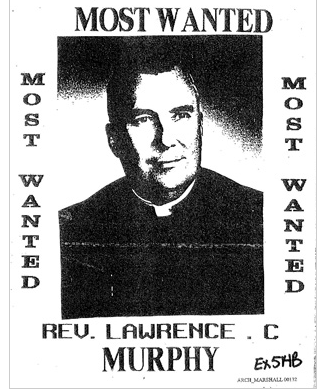
Father Lawrence Murphy, in a flyer distributed by his accusers

Father Lawrence Murphy, in a flyer distributed by his accusers


This Times interactive timeline about how Father Murphy got away is worth clicking through. Here are some of the important dates (after the last known-allegations against him):

– In Dec. 1993, Father Murphy is evaluated by the archdiocese.

– Three years later, the Milwaukee archbishop gets around to writing a letter to Ratzinger’s office.

– About half a year later, the pre-trial proceedings get held up because they’re arguing over the statute of limitations (which, according to one interpretation of canon law, is as short as 30 days).

About a year later from when the Milwaukee archbishop’s wrote a letter to Ratzinger, it finally is received by whoever is supposed to forward mail to Ratzinger’s office.

– Another year passes, and Ratzinger’s secretary recommends that Father Murphy be allowed to live the rest of his years in dignity. In the July of 1998, the Vatican sends its meeting notes to Wisconsin…and it takes about a month for them to get translated from Italian to rough English.

– In August, the Milwaukee Archdiocese puts Murphy out to pasture, promising, with almost hilarious understatement, that he plans on “strengthening the precepts that have already been placed upon Father Murphy…to assure that Father Murphy does not continue to seek contact with members of the deaf community, which often in the past has resulted in considerable dismay in the deaf community.”

– A few weeks later, Father Murphy dies. In defiance of church orders, his family gives him an open-casket funeral, with him decked out in full vestments, with invites sent out to the deaf community.

The most passionate of anti-Catholics would argue that the Church was actively covering up, and maybe even encouraging the abusive behavior of its pedophile priests. But it’s understandable how even an ardent Catholic, after reading the above-trove of documents, might conclude that the Vatican may not be covering up for predators, but it sure is dependent on an all-too human, painfully-slow bureaucracy, in which church officials spend as much time arguing over interpretation of church rules as they do criminal law and important letters are being sent over by courier in diplomatic pouches, and yet still take a year to get to the relevant official’s secretary (in another case of an abusive priest, the memo never got forwarded at all, according to the Vatican).

And even when it does reach the right official, Ratzinger in this case, there’s no guarantee that there’s enough hours in the day for him to get to it (though he did find time to punish and force a priest out of the priesthood for participating in a peace protest). If only Skype had been invented back then, maybe Father Murphy would have been punished before he was too old, as the church judged, to deserve the indignity of a trial.

I think most mature believers come to realize that, for the most part, God shouldn’t be expected to deliver miracles in quite the same immediate and dramatic fashion as depicted in the Bible. But after the case of the future Pope Ratzinger and Father Murphy, now young believers have to accept that not only will God (and his human proxy) not strike down the most evil of sinners (Matt 18:6: but whoever causes one of these little ones who believe in Me to stumble, it would be better for him to have a heavy millstone hung around his neck, and to be drowned in the depth of the sea)…He may not even make sure that the memo gets forwarded.

The other alternative is that Ratzinger (and the Pope before him) did receive and read the memos, and then did nothing. The Vatican and Douthat don’t have much wiggle room between trampling on Catholic and Christian theology, and offending basic human sensibilities.
Washington Times and Gas Prices

Besides that, how was the play Mrs. Lincoln? Or…”Besides that, Mr. Fuld, how low was your gas bill?”

The Washington Times’s crack economics team tracks the disturbing increase in gas prices under Pres. Obama’s reign:

Gas prices have risen $1 since just after President Obama took office in January 2009 and are now closing in on the $3 mark, prompting an evaluation of the administration’s energy record and calls for the White House to open more U.S. land for oil exploration.

Gas prices have been on a roller-coaster ride over the past decade, dropping to near $1 after President George W. Bush’s first year in office, crossing the $2 mark in 2005 and reaching $4 in June 2008 before Congress and Mr. Bush took action, lifting presidential and congressionally imposed moratoriums on expanding offshore drilling on the Outer Continental Shelf.

Mr. Bush lifted the presidential moratorium in July that year. The congressional moratorium expired Sept. 30, and prices fell precipitously, dropping more than $1 in October.

I wonder what else fell precipitously in September of 2008…besides demand for Lehman Brothers stocks

FOIA Trivia: “Public records, which are the evidence of official government action, are public property”

A remarkable bit of FOIA lore from Harper’s, in a post on the Pentagon vs. WikiLeaks (the latest fight is apparently about what Wikileaks says is decrypted video of an airstrike):

Which young Illinois legislator, who would become a rising, polarizing star in American and world politics in the 2000s, was a fervent advocate of the right to access government records?

In a debate over the Freedom of Information Act, a young Congressman from Illinois spoke in favor of freeing public records:

[It] “will make it considerably more difficult for secrecy-minded bureaucrats to decide arbitrarily that people should be denied access to information on the conduct of government or to how a …. government official is handling his job. Public records, which are the evidence of official government action, are public property, and there should be a positive obligation to disclose this information upon request.”

The same Congressman also said in that debate:

“We have said that ours is a government guided by citizens…From this it follows that government will serve us well only if the citizens are well informed.”

A final clue: To the White House, who opposed the bill, the Illinois congressman stated (PDF):

The unanimous action after years of delay [in passing FOIA] results from the growing size and complexity of the federal government, from its increased role in our lives, and from the increasing awareness of Americans of the threat involved in government secrecy on vital records effecting their fate.

With the continuing tendency toward managed news and suppression of public information that the people are entitled to have, the issues have at last been brought home forcefully to the public.

The name of the gentleman from Illinois: Donald Rumsfeld.

At the time of the 1966 debate and passage of FOIA, Rumsfeld was in the opposition party; the Republicans hoped that FOIA, besides ostensibly improving the operations of government with transparency, would uncover information that would embarrass Pres. Lyndon Johnson. Johnson so opposed FOIA that he refused to have a signing ceremony for the bill and tacked on a signing statement (PDF) that undercut the law based on national security concerns.

A decade after FOIA’s passage, Rumsfeld was President Ford’s chief of staff. He, along with Dick Cheney and Antonin Scalia, convinced Ford to veto amendments that were intended to strengthen FOIA. The veto was overridden in the House, though, by a margin of 371-31.

About two decades after that, Rumsfeld would become the chatty, document-divulging, and otherwise champion of transparency and Secretary of Defense who the press would come to adore and cherish.

In his resignation letter to President Bush, Rumsfeld wrote that how his only regret was that he did not do even more to keep government free and open. Oh wait…

The Foreclosure crisis, on an Arizona Street

a
Loved this story in the New York Times about the loathing, self-loathing, and helplessness in the real-estate crash, epitomized by the residents on a single Arizona street racked with foreclosures.

She said she did not feel she deserved to have her debts forgiven, but added that if her mortgage had been lowered, she would have tried harder to stay. The worst part, she said, is that her decision will hurt Mr. Setbacken, who has watched out for her over the years. “For Gary, he’s going to have to deal with the ramifications of what I’m doing because I’m bringing his property value down,” she said. “I pray at church. I feel horrible for what I’m doing to my neighbors.”

It’s easy to be angry and unsympathetic towards the homeowners who bought beyond their means and accelerated the housing crisis. But as the change of heart in one of this story’s residents argues, it’s not a practical solution and it’s not a human response.

Kim Ung-yong: A genius striving for mediocrity

Came across this wikipedia article on Kin Ung-Yong (mentioned in this Reddit discussion on why The Big Lebowski is so great): Kim was in the Guinness Book of World Records for highest IQ (210), could read four languages by the age of 3, and earned his PhD in Physics before 16. However, he settled for being a professor in civil engineering at a mediocre university, just so he could live a normal life.

“Unmasking Horror: Japan Confronting Gruesome War Atrocity” from the archives of the New York Times

A 1995 article by the NYT’s Nicholas Kristof, with an unforgettable, chilling lede:

ORIOKA, Japan— He is a cheerful old farmer who jokes as he serves rice cakes made by his wife, and then he switches easily to explaining what it is like to cut open a 30-year-old man who is tied naked to a bed and dissect him alive, without anesthetic.

“The fellow knew that it was over for him, and so he didn’t struggle when they led him into the room and tied him down,” recalled the 72-year-old farmer, then a medical assistant in a Japanese Army unit in China in World War II. “But when I picked up the scalpel, that’s when he began screaming.

And this dark humor:

Japan’s biological weapons program was born in the 1930’s, in part because Japanese officials were impressed that germ warfare had been banned by the Geneva Convention of 1925. If it was so awful that it had to be banned under international law, the officers reasoned, it must make a great weapon.

And the relevance today, if you believe that those who forget history are doomed to repeat it:

The research was kept secret after the end of the war in part because the United States Army granted immunity from war crimes prosecution to the doctors in exchange for their data. Japanese and American documents show that the United States helped cover up the human experimentation. Instead of putting the ringleaders on trial, it gave them stipends.

Iowa is just Maid Rite

Maid-Rite...mmmm....Loose Meat

New York refuses to give homosexuals equal marriage rights and, with that work out of the way, has moved on* to trying to ban salt from restaurants so that, I don’t know, no one ever has to die, ever…or enjoy life, in general, or something.

Meanwhile, Iowa lets gays marry and its state senate just approved a measure that protects the traditional-but-possibly-dangerous-bacteria-friendly method of cooking Iowa’s signature sandwich, the Maid-Rite…because that’s how a proper “loose meat” sandwich is done in there parts.

A majority of senators sided with the Maid-Rite in Marshalltown to override concerns from state food-safety inspectors who question the restaurant’s cooking methods.

Some senators chafed at what they perceived as an attack on an Iowa icon and argued that the cooking method this Maid-Rite outlet has used for 82 years should be preserved.

“Maid-Rites are very important to me,” Sen. Dennis Black, D-Grinnell, said Wednesday. “I’m unaware of a single person that’s ever gotten sick from a Maid-Rite.”

The Iowa Department of Inspections and Appeals has told Taylor’s Maid-Rite restaurant that it must alter its process for cooking loose-meat sandwiches. The process at Taylor’s involves cooked hamburger being placed in the same heated receptacle that’s used to cook raw meat.

Iowa 2, New York 0.

*OK, it’s just one Brooklyn legislator for now. But that a state lawmaker would even waste his time pitching such a health-nanny proposal, even as a PR stunt, speaks a little to the Empire State’s views on the reach of law and personal health. Gov. Paterson** proposed a soda tax before abandoning it in the face of unpopular opinion. Bloomberg is now petitioning the state to allow him to tax soda in NYC, which, according to a New York Times back-of-the-napkin analysis, would make soda more expensive than some beers.

** Also, recent Iowa governors have so far avoided consorting with top-dollar prostitutes. And not having aides who allegedly beat up their girlfriends and have the state police cover it up.

Elementary math, in the New York Times Magazine

I haven’t read the entirety of Elizabeth Green’s (of GothamSchools.org) feature in the NYT Magazine, “Building a Better Teacher“. What I’ve read so far has been great, and this section about teaching elementary math is revealing:

On one tape from that year, Ball started her day by calling on a boy known to the researchers as Sean.

“I was just thinking about six,” Sean began. “I’m just thinking, it can be an odd number, too.” Ball did not shake her head no. Sean went on, speaking faster. “Cause there could be two, four, six, and two — three twos, that’d make six!”

“Uh-huh,” Ball said.

“And two threes,” Sean said, gaining steam. “It could be an odd and an even number. Both!”

He looked up at Ball, who was sitting in a chair among the students, wearing a black-and-red jumper and oversize eyeglasses. She continued not to contradict him, and he went on not making sense. Then Ball looked to the class. “Other people’s comments?” she asked calmly.

At this point, the class came to a pause. I was watching the video at the University of Michigan’s school of education, where Ball, who has traded in her grandma glasses for black cat’s-eye frames, is now the dean — and one of the country’s foremost experts on effective teaching. (She is also on the board of the Spencer Foundation, which administers my fellowship.) Her goal in filming her class was to capture and then study, categorize and describe the work of teaching — the knowledge and skills involved in getting a class of 8-year-olds to understand a year’s worth of math. Her somewhat surprising conclusion: Teaching, even teaching third-grade math, is extraordinarily specialized, requiring both intricate skills and complex knowledge about math.

I’ve always wondered how it was possible that some elementary school teachers, with otherwise fine teaching credentials and experience, could belong to the general population of math-phobic people yet still competently teach grade-schoolers math. It’d be like teaching English comprehension by memorization of spelling and common phrases, without being able to explain how or why a sentence is constructed.

But, Green notes, completing college coursework in math isn’t enough to competently explain the difference between even and odd numbers to children. It requires a whole other branch of application of mathematical theory:

Mathematicians need to understand a problem only for themselves; math teachers need both to know the math and to know how 30 different minds might understand (or misunderstand) it. Then they need to take each mind from not getting it to mastery. And they need to do this in 45 minutes or less. This was neither pure content knowledge nor what educators call pedagogical knowledge, a set of facts independent of subject matter, like Lemov’s techniques. It was a different animal altogether. Ball named it Mathematical Knowledge for Teaching, or M.K.T.

At the heart of M.K.T., she thought, was an ability to step outside of your own head. “Teaching depends on what other people think,” Ball told me, “not what you think.”

Read Green’s full piece here.