My favorite entertainment in Vegas this weekend:
Category Archives: thoughts
Steve Jobs, adorably wrong, 14 years ago
 Great time capsule from longform.org, a 1996 Wired interview with Steve Jobs, in which he makes a laughably wrong prediction on the impact of the web and an existential lament, long before his cancer diagnosis:
The Web is going to be very important. Is it going to be a life-changing event for millions of people? No. I mean, maybe. But it’s not an assured Yes at this point. And it’ll probably creep up on people.
It’s certainly not going to be like the first time somebody saw a television. It’s certainly not going to be as profound as when someone in Nebraska first heard a radio broadcast. It’s not going to be that profound.
We live in an information economy, but I don’t believe we live in an information society. People are thinking less than they used to. It’s primarily because of television. People are reading less and they’re certainly thinking less. So, I don’t see most people using the Web to get more information. We’re already in information overload. No matter how much information the Web can dish out, most people get far more information than they can assimilate anyway.
And here, maybe one of the more profound, humble statements from a CEO I’ve read. Puts those keynote addresses in which Jobs hops around the stage with a new gadget in a new light:
The problem is I’m older now, I’m 40 years old, and this stuff doesn’t change the world. It really doesn’t…I’m sorry, it’s true. Having children really changes your view on these things. We’re born, we live for a brief instant, and we die. It’s been happening for a long time. Technology is not changing it much – if at all.
These technologies can make life easier, can let us touch people we might not otherwise. You may have a child with a birth defect and be able to get in touch with other parents and support groups, get medical information, the latest experimental drugs. These things can profoundly influence life. I’m not downplaying that. But it’s a disservice to constantly put things in this radical new light – that it’s going to change everything. Things don’t have to change the world to be important.
The Great Wikileaks-Military Secrets Heist
Wired has posted some of the relevant chat logs between ex-hacker Adrian Lamo and Bradley Manning, the 22-year-old suspect in the Wikileaks-leak case. Reading it makes you a little ill at what passes for top-secret security in the institution that defends our country:
(01:54:42 PM) Manning: i would come in with music on a CD-RW
(01:55:21 PM) Manning: labelled with something like “Lady Gagaâ€â€¦ erase the music… then write a compressed split file
(01:55:46 PM) Manning: no-one suspected a thing
(01:55:48 PM) Manning: =L kind of sad
(01:56:04 PM) Lamo: and odds are, they never will
(01:56:07 PM) Manning: i didnt even have to hide anything
(01:56:36 PM) Lamo: from a professional perspective, i’m curious how the server they were on was insecure
(01:57:19 PM) Manning: you had people working 14 hours a day… every single day… no weekends… no recreation…
(01:57:27 PM) Manning: people stopped caring after 3 weeks
(01:57:44 PM) Lamo: i mean, technically speaking
(01:57:51 PM) Lamo: or was it physical
(01:57:52 PM) Manning: >nod< (01:58:16 PM) Manning: there was no physical security
(01:58:18 PM) Lamo: it was physical access, wasn’t it
(01:58:20 PM) Lamo: hah
(01:58:33 PM) Manning: it was there, but not really
(01:58:51 PM) Manning: 5 digit cipher lock… but you could knock and the door…
(01:58:55 PM) Manning: *on
(01:59:15 PM) Manning: weapons, but everyone has weapons
(02:00:12 PM) Manning: everyone just sat at their workstations… watching music videos / car chases / buildings exploding… and writing more stuff to CD/DVD… the culture fed opportunities
So this is the security blocking secrets so sensitive to our national security and diplomacy? It’s not hard to sympathize with the militia-types who don’t want to even hand over their last names to a welfare agency. What do the low-level domestic grunts watch while “securing” that data, the Lifetime Channel?
Also, an excerpt in which Manning describes what made him turn against his country (hint: something to do with detainee treatment; kind of amazing how that is becoming an endless source of misery for both detainee and detainers):
(02:31:02 PM) Manning: i think the thing that got me the most… that made me rethink the world more than anything
(02:35:46 PM) Manning: was watching 15 detainees taken by the Iraqi Federal Police… for printing “anti-Iraqi literatureâ€â€¦ the iraqi federal police wouldn’t cooperate with US forces, so i was instructed to investigate the matter, find out who the “bad guys†were, and how significant this was for the FPs… it turned out, they had printed a scholarly critique against PM Maliki… i had an interpreter read it for me… and when i found out that it was a benign political critique titled “Where did the money go?†and following the corruption trail within the PM’s cabinet… i immediately took that information and *ran* to the officer to explain what was going on… he didn’t want to hear any of it… he told me to shut up and explain how we could assist the FPs in finding *MORE* detainees…
(02:36:27 PM) Manning: everything started slipping after that… i saw things differently
Also, Manning divulges details about his preferential treatment by Assange, which would explain Assange’s reported efforts to mount a legal defense of Manning…or at least advise him not to spill anymore of the Wikileaks operational secrets.
Wikileak’s Julian Assange cancels IRE appearance amid manhunt; Did he lie on Twitter?

(Updates:
– As it turns out, Assange did not appear at the IRE showcase panel in any form, except as mugshot image on the Daily Beast story on a projector screen. He and Wikileaks did dominate the discussion, with most of the panelists agreeing that Wikileaks was, in theory, a good idea, but not comfortable with the vetting process and agenda of the operation. Valerie Plame said, to the laughter of the reporters in attendance, that sometimes secrecy is good.
With respect to the esteemed members of the panel who did show up (James Risen of the NYT also was a no-show on the advice of his lawyer), I think everyone was a little letdown with Assange’s absence. I don’t think there was any new ground covered in terms of the “risks and rewards” of anonymous sources…but hearing reps. from the traditional media debate Assange over Wikileaks’ motives and methods would’ve been very illuminating.
I misspelled Horvit’s name because I trusted but didn’t verify Daily Beast’s spelling. Also, maybe the tweet was not a flat-out lie. Just a very sly truth. Still, having to second guess what really is the “truth” still undermines Wikileaks’ ideal for transparency. Also, I think that if Assange’s arrest is an inevitability…there would’ve been no better place to get it over with than at a conference full of the most righteous journalists)
Bummer…I can’t be the only one who thought that despite the other luminaries on IRE’s showcase panel on anonymous sources, most of the interest would be the super-secretive Wikileaks founder.
According to the Daily Beast, IRE executive director Mark Horvik Horvit said Assange canceled “within the last several days as a result of unspecificed ‘security concerns.'” The Beast also points out that last week, at a New York panel, Assange only appeared via Skype from Australia, citing his lawyer’s recommendation that he not go back to the U.S.
So did Assange ever intend to show up at IRE? When did IRE know, and if they knew beforehand and were asked about it, were they obliged to tell the truth as soon as they knew it or feign ignorance for Assange (it’s possible this is old news for the other IRE attendees, but I hadn’t heard it until reading it on the Daily Beast)?
Apparently, the Twitter Wikileaks account, on the morning of Assange’s scheduled IRE appearance, tweeted “Super panel tonight in Vegas with Julian Assange, Valerie Plame & Scott Risen | IRE10“. So, if Horvit is to be believed, the wikileaks account is either not connected to Assange at all, or is being used as tool for deliberate misinformation.
I understand Assange’s need to cover his tracks, but it strikes me as very bad precedent for Wikileaks, which purports itself to be the brave dispenser of unfiltered truth, to use its official channel of communication to tell a flat-out lie (on second thought, maybe it’s not a lie. It’s still a “super panel”, and maybe Assange will show up via skype?). Many governments tell lies based on such justifications of self-preservation.
And besides, what’s the point of sullying your reputation, even if only in a tweet? Does he really think the military manhunters would be so easily thrown off the trail, as if their only investigative tools were looking at someone’s twitter account? Oh wait, this is the same military that let a 22-year-old download hundreds of thousands of top-secret files because he bypassed their security measures by lip-syncing to Lady Gaga.
(*piteous cry*)
Wired had an interesting folo today, about suspect Bradley Manning’s crisis of conscience. According to his chat logs with ex-hacker Adrian Lamo, Manning claimed that Assange offered him a position at Wikileaks…which would go against several tweets and statements by Wikileaks and Assange.
But Wired’s lead reporter on this case, felon ex-hacker Kevin Poulsen, should not be trusted, according to Wikileaks. But Wikileaks, as far as we know at this point, is not always telling the (whole) truth in its tweets…
Violinist playing Lady Gaga on the Las Vegas Strip
Violinist playing Lady Gaga’s ‘Paparazzi’ and ‘Poker Face’ on Las Vegas Strip, originally uploaded by zokuga.
Maybe New Yorkers are more appreciated of the arts compared to the average Las Vegasan, but how are people just walking by this? Maybe he needed to break out “Telephone” or “Bad Romance”
Lady Gaga Beats DoD: re Bradley Manning, the Alleged Wikileaks/Collateral-Murder Leaker

Wired’s Threat Level blog blows open the door on the Wikileaks/Collateral Murder mystery by naming a suspect: SPC Bradley Manning, 22, of Potomac, Md., who apparently had top-secret access and was arrested two weeks ago:
Manning was turned in late last month by a former computer hacker with whom he spoke online. In the course of their chats, Manning took credit for leaking a headline-making video of a helicopter attack that Wikileaks posted online in April. The video showed a deadly 2007 U.S. helicopter air strike in Baghdad that claimed the lives of several innocent civilians.
He said he also leaked three other items to Wikileaks: a separate video showing the notorious 2009 Garani air strike in Afghanistan that Wikileaks has previously acknowledged is in its possession; a classified Army document evaluating Wikileaks as a security threat, which the site posted in March; and a previously unreported breach consisting of 260,000 classified U.S. diplomatic cables that Manning described as exposing “almost criminal political back dealings.â€
Wired.com could not confirm whether Wikileaks received the supposed 260,000 classified embassy dispatches.
OK, if the charges are true, then this is the most alarming part of the story. Someone, who at the time of the alleged crime was barely old enough to legally drink, was able to copy volumes of top secret files because the military has an IT policy weaker than your Starbucks’ does. The famed air-gap – having servers completely disconnected from the Internet – was overcome by a kid who copied files onto a CD labeled “something like ‘Lady Gaga’”:
Manning had access to two classified networks from two separate secured laptops: SIPRNET, the Secret-level network used by the Department of Defense and the State Department, and the Joint Worldwide Intelligence Communications System which serves both agencies at the Top Secret/SCI level.
The networks, he said, were both “air gapped†from unclassified networks, but the environment at the base made it easy to smuggle data out.
“I would come in with music on a CD-RW labeled with something like ‘Lady Gaga’, erase the music then write a compressed split file,†he wrote. “No one suspected a thing and, odds are, they never will.â€
“[I] listened and lip-synced to Lady Gaga’s ‘Telephone’ while exfiltrating possibly the largest data spillage in American history,†he added later. â€Weak servers, weak logging, weak physical security, weak counter-intelligence, inattentive signal analysis… a perfect storm.â€
Even worse, he did this undetected until he was foolish enough, reportedly, to talk to an FBI informant, ex-hacker Adrian Lamo (who Wired profiled last month).
And hey, what about that time when WikiLeaks released footage of U.S. gunships gunning down civilians and the military said they couldn’t confirm it as totally real because they had lost their own copy? According to Wired’s account, Manning tells Lamo specifically where he got the video…why don’t we see if it’s still there?
“At first glance it was just a bunch of guys getting shot up by a helicopter,†Manning wrote of the video. “No big deal … about two dozen more where that came from, right? But something struck me as odd with the van thing, and also the fact it was being stored in a JAG officer’s directory. So I looked into it.â€
Read More http://www.wired.com/threatlevel/2010/06/leak/#ixzz0qB1oYOCN
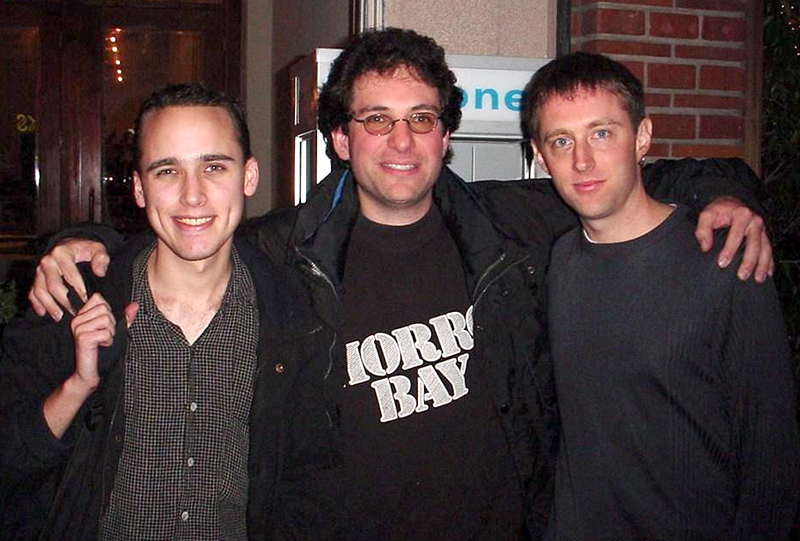
One last point. The Wired article is pretty amazing in its detail; it’s pretty obvious that Lamo divulged the case to Wired in such a way that they felt comfortable working on it for a couple weeks before breaking the story. But, as @Wikileaks insinuates, how come no mention in the article of the relationship between the Wired author, ex-black-hat Kevin Lee Poulsen and Lamo…if any? Is this photo of Poulson and Lamo just a random-pose-with-a-celeb-hacker-on-the-street?

More from the NYT Lede.
NYT: U.S. Funding Both the Afghan Government, and an Afghan Warlord Who Undermines It
An illuminating front-page story today by the Times’ Dexter Filkins, on how the U.S./NATO strategy to mesh Special Forces with the locals has led to a situation in which millions of dollars – monthly – is given to a Matiullah Khan, a warlord who fights the Taliban, yet threatens the official government that the U.S. hopes will bring stability to the region.
Khan is billed as a “lesser of two evils” and is providing security through a Taliban-thick region. But how will this strategy differ in its end-game than the short-term-gain, long-term-loss strategies we’ve used in the past to stabilize Afghanistan?
In little more than two years, Mr. Matiullah, an illiterate former highway patrol commander, has grown stronger than the government of Oruzgan Province, not only supplanting its role in providing security but usurping its other functions, his rivals say, like appointing public employees and doling out government largess. His fighters run missions with American Special Forces officers, and when Afghan officials have confronted him, he has either rebuffed them or had them removed.
“Oruzgan used to be the worst place in Afghanistan, and now it’s the safest,†Mr. Matiullah said in an interview in his compound here, where supplicants gather each day to pay homage and seek money and help. “What should we do? The officials are cowards and thieves.â€
Deeper into the story, Filkins reports suspicions that Matiullah and the other U.S. backed-warlords are suspected of protecting the opium trade, and even worse, secretly boosting the Taliban so that the chaos – and thus the need for Matiullah’s services – continues:
A former senior official in the Kandahar government, who spoke on the condition of anonymity for fear of retribution by Mr. Matiullah and the Karzais, said he believed that Mr. Matiullah was facilitating the movement of drugs along the highway to Kandahar.
“I was never able to look inside those trucks, but if I had, I am fairly certain what I would have found,†he said.
Despite his relationship to the Special Forces, Mr. Matiullah has been suspected of playing a double game with the Taliban. Asked about Mr. Matiullah earlier this year, an American military officer in Kabul admitted that Mr. Matiullah was believed to have a relationship with insurgents. He spoke on the condition of anonymity because he was discussing intelligence matters.
Hopefully, this is just a phase, with the happy ending being that the shadow government set up by Matiullah is gently, but doggedly nudged with American carrots and sticks to merge with the official, legitimate one as Afghanistan stabilizes. Because we’ve learned from the last time we backed a charismatic insurgent in Afghanistan, right? Right?
Ron Paul and his family
For as interested I was in Ron Paul during his plucky, unsuccessful 2008 presidential bid, I’ve been far less up-to-speed on his son Rand Paul, who stands a greater chance of winning and impacting American politics from a Kentucky Senate position.
That said, I loved reading about the family dynamics in this New York Times profile, and it reminded me why I respected Ron Paul even if I could never be confident that his policies would work at all on a national scale:
In keeping with their position as the First Family of Libertarianism, the Pauls of Lake Jackson, Tex., did not have many rules around their home.
“Behave yourself and be polite†is how Representative Ron Paul describes his regulatory philosophy about rearing five children. Mr. Paul, a Republican, and his wife of 53 years, Carol, never believed in assigned chores or mandates.
They did not give out allowances, which they viewed as a parental version of a government handout. They did not believe in strict curfews; Mr. Paul says that unintended consequences — like speeding home to beat the clock — can result from excessive meddling from a central authority.
I’m not a parent, but it’s hard to imagine any parent being strongly against the ideals of the Paulian parenting philosophy, in principle. So the implications of how the Pauls ran their family is a microcosm, perhaps, of how their policies might and might not work for the country as a whole: what works well in middle-class Texas (the NYT describes the neighborhood they’ve lived in, since 1968, as “where the streets are named for trees, flowers and fauna (the Pauls live on Blossom)“) may not be practical in Chicago or Fresno or New York City.
Still, I admire how Ron Paul strongly practiced what he preached: a conservative Christian who not only hasn’t been caught in sexual scandal, a military man who wants to cut the military-industrial complex, and a principled man who allows his intellectual principles overrule his personal moral proclivities. Does any other exist in our current political system?
This clip of him debating the War on Drugs on the Morton Downey Jr. show, a talk show that looks like how Jerry Springer would run the Newshour, is what piqued my interest in Ron Paul. If you watched it on mute, you’d think the smug, squarely-dressed elderly man was lecturing the crowd of angry, pot-smoking college kids on the dangers of drugs.
Quite the opposite:
The full segment of the show is just a wondrous thing to watch, entertaining, thought-provoking, and awesome overall 80’ness. Can you think of any contemporary U.S. politician being told, by the host, that he deserves to be puked on, and then called a white, elitist potatohead, and then respond by not only NOT walking out in anger, but in complete sentences with multi-syllabic words? (Chuck Rangel makes a cameo, but only by phone)
I don’t know enough about Rand Paul, or his opponent, to know who would be better for the Kentucky Senate seat (my first guess is that he doesn’t have the intellectual rigor and commitment and wisdom, yet, of his father)…but the thoughful, side-burns-styled Ron Paul of the 80s (who doesn’t seem to have changed much in policies since then) couldn’t be the worst thing this country’s had in its esteemed Senate.
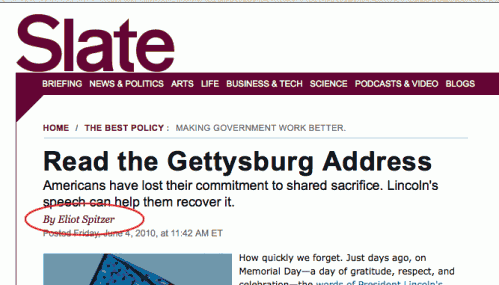
Slate just won’t let Eliot Spitzer shake his past
So, either Slate’s content-management system has gone awry, by associating an article about how Americans should embody the principles of the Gettysburg Address with an article titled “Rape, Fantasies, and Female Arousal“:

Or that’s the kind of article people like to go to when searching for the author of that Gettysburg article:
Kagan Documents Released by Clinton Library
Previously, I went on a rant about how the Obama administration was being heavy-handed in keeping Supreme Court nominee Elena Kagan under wraps. Today, they released thousands of documents relating to Kagan from the Clinton library.
Great news. So why even bother making it look like she had something to hide in the first place?