Author Archives: Dan Nguyen

Jewelry Design 101 (Intro to Jewelry Fabrication) at the Fashion Institute of Technology

This is what you have to buy for the Introduction to Jewelry Fabrication class at FIT. (Kit from Allcraft Jewelry Supply)

Click to embiggen picture of my tools

Quantity Item Descriptim Unit Price Extension
1.00 XX X BRASS BARS 3.95 3.95
1.00 FILE-6-2 SET 6 ECONCMY NEEDLE FILES 2 7.00 7.00
1.00 PCX X 1/2 ROUND ECONOMY FILE 7.00 7.00
1.00 WET&DRY SET SAND PAPER 220,,400,600 3.00 3.00
1.00 523-1826 COPPER SHEET 6X6X18~ 6.50 6.50
1.00 525-1826 BRASS SHEET 6X6X18GA 6.50 6.50
0.50 529-1826 NICKEL SILVER SHEET 6X6X18GA 9.75 4.88
1.00 002-0102 SAWFRAME 4 13.00 13.00
2.00 003-1008 JEWELERS SAWBLADES:#O 1.95 3.90
1.00 004-0884 TWIST DRILLS:SET OF 6 6.00 6.00
1.00 XX X CENTER PUNCH 1.60 1.60
1.00 54.210 ABESTOS FREE PAD 6X6X1/2 7.50 7.50
1.00 SOLDER PIC SOLDER PIC 3.95 3.95
1.00 54.44 PASTE FLUX-DANDIX 1-1/2 OZ 4.95 4.95
1.00 SOLDER-SET OF 3 SET OF 3 SILVER SOLDER:E,M.H 8.95 8.95
1.00 ~X X POLISHING KIT 3.50 3.50
1.00 CHUCK CHUCK KEY 3.95 3.95
2.00 060-0209 MANDRELS: #9 1.20 2.40
1.00 060-0202 MANDRELS:#2 0.95 0.95

Subtotal 99.48
Sales Tax 8.83
Freight 0.00
TOTAL ORDER AMOUNT 108.31

A good way for Google Buzz to recruit the dumbest users on Facebook

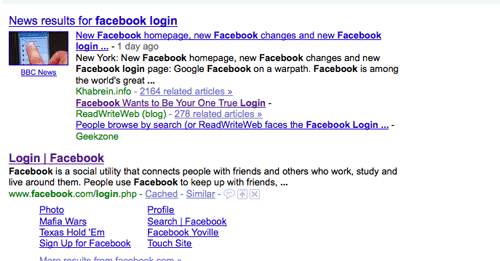
My colleague Jeff pointed out this ReadWriteWeb article on how Facebook wants to be the web’s main login service. It apparently jumped to the top of Google’s search results…which means trouble for the kind of people who Google “Yahoo”, in order to find yahoo.com.

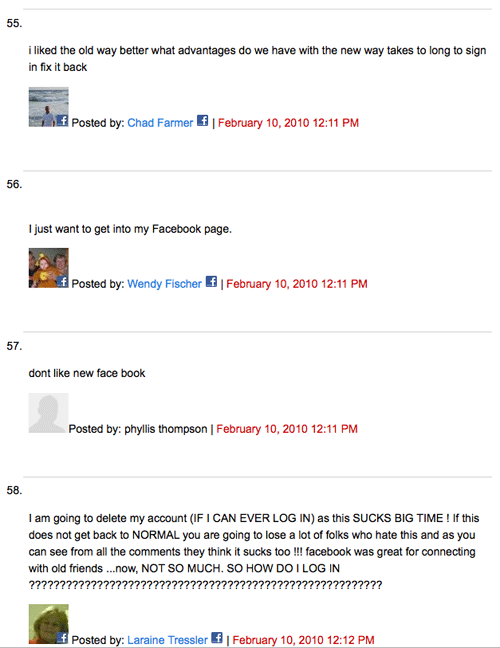
Incidentally…these are the kind of people who are too dumb to tell the difference between a blog article about Facebook and a Facebook redesign. As evidenced by these hilariously confused comments:

I am going to delete my account (IF I CAN EVER LOG IN) as this SUCKS BIG TIME ! If this does not get back to NORMAL you are going to lose a lot of folks who hate this and as you can see from all the comments they think it sucks too !!! facebook was great for connecting with old friends …now, NOT SO MUCH. SO HOW DO I LOG IN ?????????????????????????????????????????????????????????

Laraine T Posted by: Laraine T. Author Profile Page | February 10, 2010 12:12 PM

If Google is looking for a not-totally-evil-but-still-really-mean way to lure Facebook users over to Buzz…its algorithm could place an article about Facebook on buzz.google.com at the top of the search results for “Facebook login.” But then you’d only lure the most clueless from Facebook…and if Facebook login is an obstacle for them…Buzz is going to have them punch their monitors out.

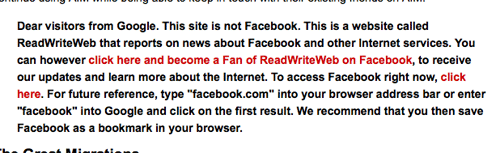
ReadWriteWeb helpfully put up this notice for wayward Google users:

Google Buzz == Gwitterbook

Well, my first impression of Google Buzz is that it’s a convenient way to FriendFeed my stuff to Google contacts. But I’m surprised at how poor of an interface it released with…I can’t recall the last major online service where I’ve been so confused on how to perform as simple a task as finding the settings panel. For example, last night I stumbled upon the option to set my Buzz to be “Public” or “Private”…and it took me awhile to remember how I got there this morning. The shortest path that I’ve found is to click on my own name in Google Buzz, then find the “profile link”, which takes me to another intermediary page where I have to divine that the link “Add more info to profile” will take me to a few basic privacy settings.

How about a simple “Privacy settings” link that Facebook wisely added at least a year ago? Why didn’t Google learn such an obvious feature from the leader?

This confusion is pretty inexcusable given that I’ve been on GMail for at least four years…this interface should be at least halfway intuitive. Even worse, there’s little to assure me how specific and granular these settings are. Facebook deserves to be criticized for its privacy missteps, but it’s done a fine job in giving us a huge amount of flexibility in designating what is viewable to whom.

With Buzz, I know there’s some kind of change between a “Private” and “Public” Google profile…but does setting it Private also make it so that random people can’t follow my Buzz? Or just that my profile information (city, date of birth, mugshot, etc) is hidden? Maybe Buzz wanted to go for the “Apple” approach in arrogantly deciding what’s best for the user in order to have the most clutter-free interface. But I think privacy concerns trump having a lowest-common-denominator interface.

Especially since Google is already in the limelight for owning too much of our personal information. Now they’ll have a database of every status update you made, and if it was from your phone, where you were.

Google’s sloppy approach has already made for some awful PR: WARNING: Google Buzz has a huge privacy flaw, says Silicon Alley, referring to how Buzz automatically sets you up to follow your most-contacted people.

I wouldn’t call that a huge privacy flaw…99% of people would be OK with following the people they message the most. But for journalists who may be using GMail for contacting anonymous sources…that’s a horrible default setting. Actually, I think the problem is that by default, this list of followers is publicly available…unless you go into the settings and find the appropriate checkbox. Now how do you get to the privacy settings again?…

NYT: How Unemployment Taxes are Collected; Also, Watch Your Texting Habit

A pretty interesting piece in Jay Goltz’s “You’re the Boss” blog on how unemployment tax is paid for (in Illinois, an employer can pay up to $1.48 per dollar that a former employee collects in unemployment benefits). Goltz argues that this creates a disincentive for employers to hire, knowing that a prospective employee who turns out to be a failure will cost the company in time lost and extra unemployment tax.

Speaking of which, there’s this amusing nugget of a negligent employee who almost cost Goltz’s company that incremental tax, despite “working” for 21 days:

I have recently learned that you can be charged with a claim even if you’ve employed someone for less than 30 days. We fired someone after three weeks because she was text-messaging her friends all day. After we told her twice that she had to work during the day and stop texting, she put her phone away. We then noticed she was leaving her desk drawer open and looking into it a lot. She was now texting out of the drawer.

Now is a good time to refer to my colleagues Jeff Larson and Olga Pierce’s fantastic work in documenting the crisis in states’ unemployment insurance funds. Jeff devised a pretty smart way to scrape the information, and he and Olga came up with a formula to accurately predict whether states’ funds were in the red (see their nerdy formula page here).

Incidentally, Illinois, Goltz’s state of business (he owns five small Chicago businesses), is in the shitter for its unemployment funds, so to speak, according to ProPublica’s Unemployment Insurance Tracker.

Letter from the Wikimedia Community Health Task Force

My first thought at the sender’s name was that the Wikiworld was going to put its crowdsourcing muscle into crafting a heatlh-care bill. But no, apparently I haven’t been contributing enough to Wikipedia, as I received this email today:

from Wikimedia Community Health Task Force
date Tue, Jan 26, 2010 at 8:43 PM
subject Survey from Wikipedia
mailed-by wikimedia.org

Hello

We are studying the habits of Wikipedia contributors, seeking to identify and address reasons why people stop contributing. We noticed that you haven’t made any edits in a while, and we’re wondering where you’ve been.

We would appreciate 5 minutes of your time to complete an online survey. We’re constantly looking for ways to improve our community and your responses will help us understand what Wikipedia is doing well and what we can improve on.

Please click on the link below to be directed to the survey.

http://survey.wikimedia.org/index.php?sid=15963&newtest=Y&lang=en

Thank you for contributing to Wikipedia and for your help in improving our community.

The Wikimedia Community Health Task Force
http://strategy.wikimedia.org/wiki/Task_force/Community_Health

The Wikimedia Community Health Task Force represents a group volunteers examining ways to improve the health of the communities for the Wikimedia projects, including Wikipedia.

As always, we are very careful to protect your privacy. Responses will be reviewed anonymously and data will be presented in aggregate form only.

This calls to mind the WSJ article a few months back about how 49,000 Wikipedia volunteer editors stopped editing in the first quarter of 2009 (compared to a net loss of 4,900 in during the same period in 2008). Frustration with overzealous editors rejecting work is cited as a big reason. I’ve never had that experience…I’m mostly submitted grammar and style changes which, for the most part, still remain. Also, wikipedia has just become so solid a source that it’s hard to contribute anything that feels valuable without really putting a lot of effort into it. I made a lot more edits back when proper nouns were misspelled. Now, fixing a comma splice doesn’t have the same satisfaction.

The survey’s questions:

1: When did you start editing?

2: When did you make your last edit?

3: During your time as an active editor, roughly how many edits did you make in a typical month?

4: *Why did you start contributing to Wikipedia?
# I saw a typo or small error and wanted to fix it
# There was information that I wanted to add
# I like the idea of volunteering to share knowledge
# I enjoy researching and writing
# I was assigned to do it (e.g., by work or school)
# I wanted to test Wikipedia to see if it was really open for anyone to edit
# Friends of mine were doing it

: * Why did you stop contributing to Wikipedia?
Check at most 3 answers

* I had other commitments (e.g. new job, new hobbies, started a family).
* I contributed enough information to improve the articles I was interested in.
* Writing an encyclopedic article is difficult and/or time consuming.
* Editing and maintaining articles takes too much time for me.
* Wikipedia is too confusing.
* I felt that I was often working alone, with little feedback or support.
* I found the atmosphere unpleasant.
* Some editors made Wikipedia a difficult place to work.
* I haven’t stopped contributing.
* Other:

6: At the time of your last edit, did you personally feel like you still had a lot to add to the Wikipedia?

7: What was your most rewarding experience with Wikipedia? Why?

8: What was your worst experience with Wikipedia? Why?
(Answers will be kept anonymous and no action will be taken. This is for survey purposes only.)

9: *Did the difficulty of the work have an impact on your decision to stop contributing?
Check at most 3 answers

* Yes. Writing an article is too difficult, or too much work.
* Yes. I had difficulties with the editing interface.
* Yes. I had difficulties with the discussion interface.
* Yes. Watching and maintaining multiple articles was difficult/took too much time.
* Yes. I had trouble understanding the rules about Wikipedia content.
* Yes. I had trouble understanding the rules about volunteer behavior.
* No. Complexity was not a major reason in my decision to leave.
* No. I haven’t stopped contributing.

10: Did the community have an impact on your decision stop contributing?
Check at most 3 answers

* Yes. I asked for help, but did not receive the help that I needed.
* Yes. I did not receive much feedback or appreciation for my work.
* Yes. I was warned or sanctioned and decided to leave.
* Yes. It took too much time to discuss content and build support for changes.
* Yes. Several editors were rude to either me or my peers.
* Yes. Several editors were too stubborn and/or difficult to work with.
* Yes. My work kept on being undone.
* No. The community was not a major reason in my decision to leave.
* No. I haven’t stopped contributing.
* Other:

11: *On a scale of 1-5, how likely are you to start contributing again?

12: Please read the following statements and select all that you believe are TRUE.

Check any that apply

* I stopped contributing because of something that happened in my life: it had nothing much to do with Wikipedia.
* I regret that I had to stop editing Wikipedia.
* When I think back on my time editing Wikipedia, I feel anger, frustration, or other unpleasant emotions.
* I would (or do) tell my friends to consider editing Wikipedia.
* I think I am very different from the typical Wikipedia editor.
* I will never edit Wikipedia again.
* I hope one day to edit again, if changes in my personal or work circumstances make that possible for me.
* I hope one day to edit again, if changes at Wikipedia make that possible for me.

13: Is there anything else you would like us to know?

14: What is your Wikipedia username? (Optional)

15: *Would you be willing to have someone contact you for a 10-minute phone call or online chat to further discuss your experience with Wikipedia?

I’m guessing that the “Wikimedia Community Health Task Force” is a new initiative, as a google search for that term brings up this blog entry as the first result.

ProPublica tracks the bailout, a year or so later

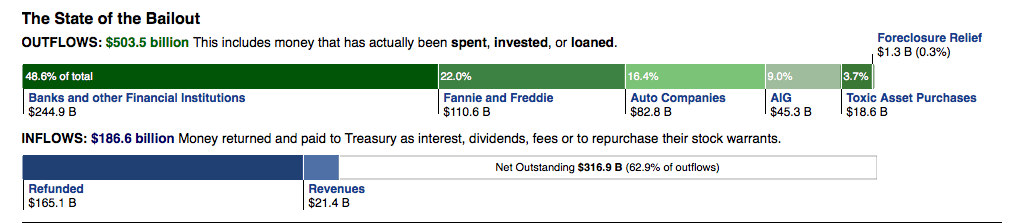
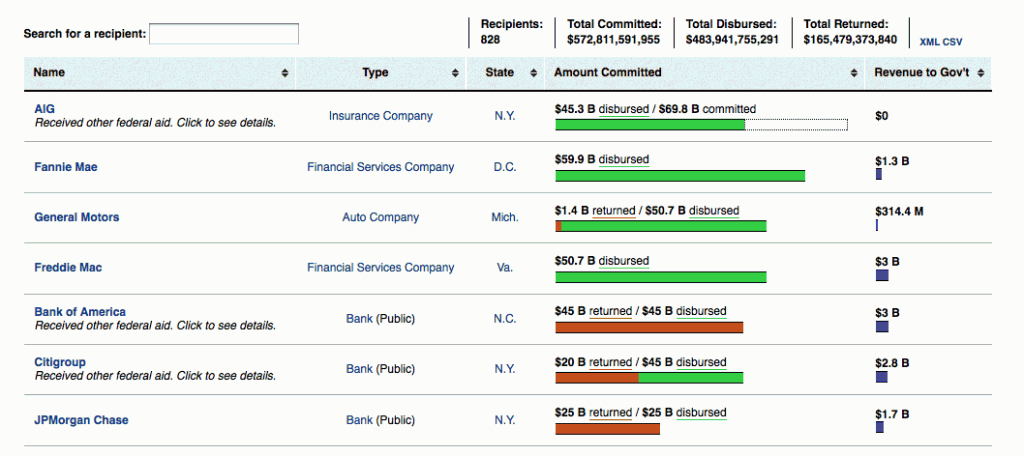
Today, my ProPublica colleague Paul Kiel and I put out some graphical revisions to PP’s bank bailout tracking site, including our master list of companies to get taxpayer bailout money:

Graphic: The Status of the Bailout

Graphic: The Status of the Bailout

Bailout List Page

Bailout List Page

Nothing fancy, mostly made the numbers easier to find and compare. The site itself has been far-from-fancy at its inception, since it was my first project after taking a crash course on Ruby on Rails. Back when the bailout was first announced in Q4 2008, the Treasury declined to name the banks it was doling taxpayer money to, for fear that non-listed banks would take a hit in reputation. Paul was one of the first few people to comb through banks’ press releases and enter them into a spreadsheet. His list of the first 26 – put into a simple html table – was a pretty big hit.

As the list grew into the dozens and hundreds, it became more cumbersome to maintain the static list, which was nothing more than the bank’s name, date of announcement, and amount of bailout. Plus, it was no longer just one bailout per company; Citigroup and Bank of America were beneficiaries of billions of dollars through a couple other programs.

So, I proposed a bailout site that would allow Paul to record the data at a more discrete level…up to that point, for example, most online lists showed that AIG had several dozen billion dollars committed to it, but not the various programs, reasons, and dates on which those allocations were made. A little anal maybe, but it gave the site the flexibility to adapt when the bailout grew to include all varieties of disbursements, including to auto parts manufacturers and mortgage servicers, as well as the money flow coming in the opposite direction, in the form of refunds and dividends.

I saw the site as more of a place for Paul to base his bailout coverage on (he’s been doing an excellent job covering the progress of the mortgage modification program), as I assumed that in the near future, Treasury would have its own, easy-to-use site of the data. Unfortunately, that is not quite the case, nearly a year and a half later. Besides some questionable UI decisions (such as having the front-facing page consist of a Flash map), the data is not put forth in an easily accessible method. It could be that I need to take an Excel refresher course here, but trying to sort the columns in these Excel spreadsheets just to find the biggest bailout amount, for example, throws an error.

Only in the past couple of months did Treasury finally release dividends in non-pdf form, and even then, it’s still a pain to work with (there’s no way, for example, to link the bank names in the dividends sheet to the master spreadsheet of bailouts). I would’ve thought that’d be the set of bailout data Treasury would be most eager to send out, because it’s the taxpayers’ return on investment. But, as it turns out, there is a half-empty perspective from this data (such as banks not having enough reserves to pay dividends in a timely fashion), one that would’ve been immediately obvious if the data were in a more sortable form.

ProPublica’s bailout tracking site doesn’t have much data other than the official Treasury bailout numbers; there’s all kinds of other unofficial numbers, such as how much each bank is giving out in bonuses, that people are more interested in. American University has gathered all kinds of financial health indicators for each bailout bank, too. There’s definitely much more data that PP, and other bailout trackers need to collect to provide a bigger picture of the bailout situation. But for now, I guess it’s a small victory to be one of the top starting points to find out just exactly where hundreds of billions of our taxes went to. And the why, too; Paul’s done a great job writing translations of the Treasury’s official-speak on each program.

ProPublica’s Eye on the Bailout

Haitian: “That’s life…and life, like death, lasts only a little while” (New Yorker)

Edwidge Danticat in this week’s New Yorker has a haunting short essay about his cousins in the Haitian earthquake’s aftermath. The magnitude of that disaster has been too hard to read about on a daily basis, but this obituary has the emotion of a thousand death reports.

The closer:

Everyone sounded eerily calm on the phone. No one was screaming. No one was crying. No one said “Why me?” or “We’re cursed.” Even as the aftershocks kept coming, they’d say, “The ground is shaking again,” as though this had become a normal occurrence. They inquired about family members outside Haiti: an elderly relative, a baby, my one-year-old daughter.
I cried and apologized. “I’m sorry I can’t be with you,” I said. “If not for the baby—”
My nearly six-foot-tall twenty-two-year-old cousin—the beauty queen we nicknamed Naomi Campbell—who says that she is hungry and has been sleeping in bushes with dead bodies nearby, stops me.
“Don’t cry,” she says. “That’s life.”
“No, it’s not life,” I say. “Or it should not be.”
“It is,” she insists. “That’s what it is. And life, like death, lasts only yon ti moman.” Only a little while. ♦

“Haiti, the earthquake, and my family”