Author Archives: Dan Nguyen

Eye Heart New York

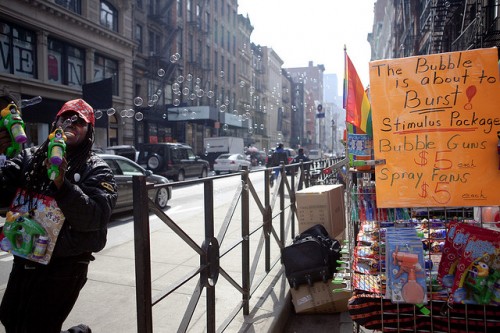
Bubble Dealer

A Bubble Dealer, on Spring St. and Broadway, shortly before the market crash of 2008

UPDATE: It is now a Tumblr: http://tumblr.eyeheartnewyork.com

It’s such a nice day out, I think I’ll make yet another blog about New York…

I’ve been looking for an area to test out HTML5, some other WP themes, and to shuffle all my New York-centric BS. I don’t know if I’ll ever complete this site about New York but at least I can get it indexed now.

Trying out Inuit Types, a half-magazine, half-blog format. Seems nice, though the image handling isn’t as flexible as I’d like. Or intuitive, at least.

NYC Resident Discovers What Shopping in a Safeway/Key Foods/Walmart Supercenter is like for Asian/Hispanic-Americans

NYC Resident Discovers What Shopping in a Safeway/Key Foods/Walmart Supercenter is like for Asian/Hispanic-Americans

From the Onion WSJ’s New York edition, “Changes in Flushing Set Off Food Fight”, a group of people feel disenfranchised by a lack of Lean Cuisine:

The recent closure of a Key Food in Flushing was the last straw for many longtime residents, who say they feel ignored and isolated. Now, they are asking the new Asian market in the area to cater to them, too.

Some non-Asian residents mourn the neighborhood’s transformation, saying it feels like a foreign country. They say the Key Food, which closed in late May, was among the last grocery stores where they could buy Lean Cuisine and deli meats.

“Most of the supermarkets in the area are Asian markets and all they have is just one single aisle of food for us,” said Rosa Febles, 50 years old, who has lived in Flushing for four decades. “We feel a little left out.”

h/t @mariancw

The Washington Post on ‘Fuck’

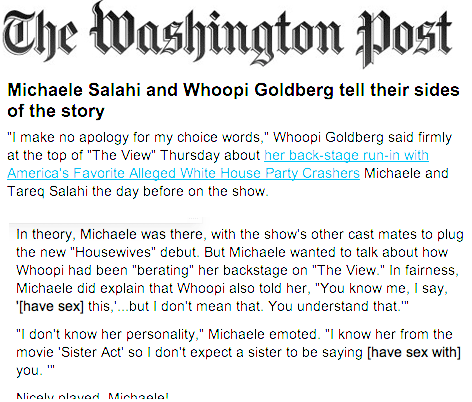
From WaPo TV critic Lisa de Moraes’s column about “The View” and Michaele Salahi, who is best known for…oh, who gives a [have sex]? Just notice how the WaPo editors handle the big F:

Washington Post's word for "Fuck"

Text:

In theory, Michaele was there, with the show’s other cast mates to plug the new “Housewives” debut. But Michaele wanted to talk about how Whoopi had been “berating” her backstage on “The View.” In fairness, Michaele did explain that Whoopi also told her, “You know me, I say, ‘[have sex] this,’…but I don’t mean that. You understand that.'”

“I don’t know her personality,” Michaele emoted. “I know her from the movie ‘Sister Act’ so I don’t expect a sister to be saying [have sex with] you. ‘”

Maybe it’s a new auto-censor they’re using? But I’m guessing a human would’ve had to add the preposition ‘with’ to the second use of the ‘fuck’-substitute…but then, what human would think that “[have sex with]” is better usage there than “[have sex]”, and also think that ‘[have sex’] is a better substitution than “F***” or “*bleep*” or “screw” or good ol’ “eff”, as MSNBC puts it? Fuck, the ‘have sex’ doesn’t even make any sense in the first usage. Is this in the style book…or maybe de Moraes is thumbing her nose at the Post’s usual way of censoring ‘fuck’?

A Google search doesn’t turn up any other obvious uses of ‘[have sex]’.

Just in case the WaPo copy desk needs a quick reference for other fill-ins to censor ‘fuck’ with, here’s a short primer (attributed, wrongly?, to Monty Python), which notes “It’s meaning is not always sexual”:

Perhaps one of the most interesting words in the English language today, is the word fuck. Of all the English words beginning with f, fuck is the single one referred to as the “f-word”. It’s the one magical word. Just by it’s sound it can describe pain, pleasure, hate and love. Fuck, as most of the other words in English, has arrived from Germany. Fuck from German’s “fliechen” which mean to strike. In English, fuck folds into many grammatical categories. As a transital verb for instance, “John fucked Shirley”. As an intransitive verb; “Shirley fucks”. It’s meaning is not always sexual, it can be used as an adjective such as; John’s doing all the fucking work. As part of an adverb; “Shirley talks too fucking much”, as an adverb enhancing an adjective; Shirley is fucking beautiful. As a noun; “I don’t give a fuck”. As part of a word: “abso-fucking-lutely” or “in-fucking-credible”. Or as almost every word in a sentence: “fuck the fucking fuckers!”. As you must realize, there aren’t many words with the versitility such as the word fuck,as in these examples used as the following words;
– fraud: “I got fucked”
– trouble: “I guess I’m really fucked now”
– dismay: “Oh, fuck it!”
– aggresion: “don’t fuck with me, buddy!”
– difficulty: “I don’t understand this fucking question”
– inquery: “who the fuck was that?”
– dissatisfaction: “I don’t like what the fuck is going on here”
– incompetence: “he’s a fuck-off!”
– dismissal: “why don’t you go outside and fuck yourself?

h/t @mariancw

NBC Bay Area (reported or ignored) Prop 8 Decision

From NBCBayArea.com:

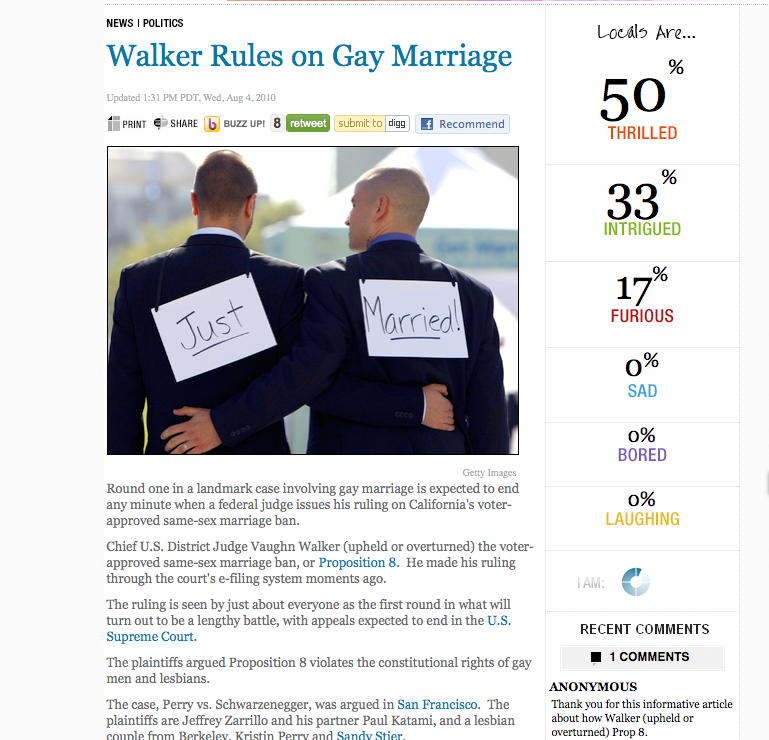
nbcbayarea-gay-marriage-png

How nbcbayarea.com reported Prop 8 Decision before everyone else

(look at the second paragraph)

Well, I guess it could be a web editor’s cynical statement of how this case is just one more step in the long legal wrangle. The following grafs, such as “Lawyers on both sides of the issue said they will appeal if Walker did not rule in their favor.”, would’ve applied no matter what.

h/t @mariancw

Anna Kendrick, etc. at the Apple SoHo store

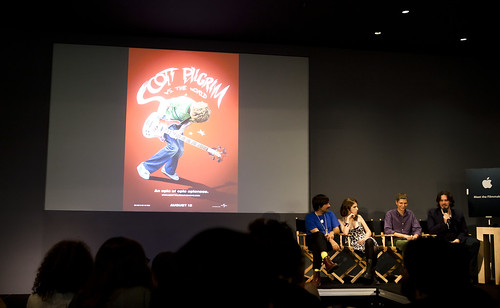
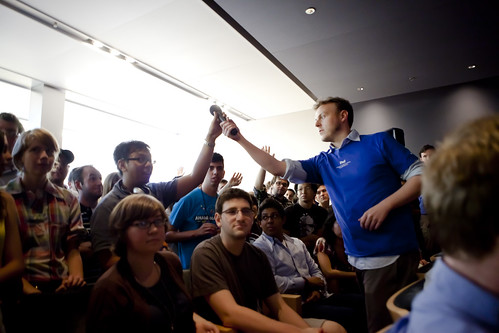
The cast of “Scott Pilgrim vs. the World” made an appearance at the SoHo Apple store. I think I was the oldest person there, except for the older uncle who was pathetically trying to give kids money for their Scott Pilgrim cheap-ass memorabilia (even for $20-$40, no kid wanted to talk to him. I ended up giving him my lanyard because I felt sorry, and the sad fellow didn’t even say thank you).

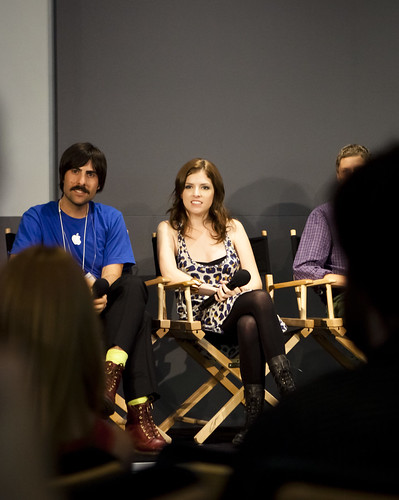
Scott Pilgrim vs. The World at SoHo Apple Store, Michael Cera, An

Scott Pilgrim vs. The World at SoHo Apple Store, Michael Cera, Anna Kendrick, Jason Schwartzman, Edgar Wright

Kendrick plays such a difficult, uptight character in “Up in the Air”, which wasn’t a favorite of mine to begin with, that you forget that behind all those acting chops is an old fashioned hottie.

Scott Pilgrim cast at SoHo Apple Store

I would’ve gone just to see Edgar Wright talk, though. Shaun of the Dead and Hot Fuzz were pretty much brilliant. Without his name behind the helm of “Scott Pilgrim”, I would’ve dismissed it as another cute-but-not-as-good-as-Superbad-Michael-Cera-teen-comedy. Cera was funny, but the awkward-kid-schtick only goes so far, it was a lot more interesting to hear Wright talk about trying to emulate Hong Kong movies.

Kill Deathhacking

Paul Carr takes on the recent spawn of Methuselah-creators (TechCrunch):

So, please God, let’s put an end to this deathhacking nonsense. Let’s flush the pills, stock up on recreational drugs, drive fast cars, work long hours and stay inspired by nature’s crippling deadline to achieve greater and greater things in our fourscore years and ten.

BP Exec Would Eat Gulf Seafood – And I Had Yet Another Simpsons Flashback

From AFP:

BP’s chief operating officer [Doug Suttles] sought to give the southern US fishing industry a much-need boost Sunday, saying he’d “absolutely” eat Gulf of Mexico seafood after the massive oil spill devastated the region.

Suttles said: “There’s been a tremendous amount of testing done…I have a lot of confidence in those agencies and I trust their recommendations and I would eat their food — the seafood out of the Gulf, and I would feed it to my family.”

Bravo for Suttles at least making a non-wishy-washy statement, and for the Gulf possibly recovering enough for him to consider putting his family on the line. But did anyone over the age of 25 who watched “The Simpsons” not immediately think of this classic second-season episode?

How De Beers Diamonds Won over the Japanese…and everyone else

Thanks to Kevin Kelly’s list of the 100 Best Magazine Articles Ever, I came across this 1982 Atlantic article, “Have You Ever Tried to Sell A Diamond?” by Edward Jay Epstein.

Most of the controversy today attached to De Beers seems to be its alleged financial role in propping up African strife. Hence the term, conflict, or “blood diamonds“. De Beers supported reforms for conflict-free diamonds, though that didn’t stop Leo DiCaprio’s “Blood Diamond” from being made.

But Epstein’s article was written in 1982, before much of the African conflict that led to diamond-for-arms selling, and so the ~10,000 word piece is all about De Beers’ unparalleled ability to drive consumer demand for diamonds, a scheme that – minus the death and suffering – is as unsettling as the idea of inadvertently propping up Third World conflicts.

During the “Blood Diamond” movie uproar, the NYT’s Donald McNeil Jr. wrote that “creating new markets is the genius of DeBeers. Getting African-American men to wear bling works for them as well as their 1950’s campaigns to get Japanese brides to demand solitaires.” The creation of the latter market makes up one of the most interesting sections in Epstein’s 1982 article, as he describes how De Beers turned post-war Japan into the second biggest market for diamonds.

Until 1959, Epstein writes, Japan hadn’t even allowed for diamonds to be legally imported. In 1967, when De Beer’s began its campaign, only 5 percent of Japanese brides received diamond rings. In 14 years, Epstein writes, that percentage rose to 60 percent.

Their strategy? Good ol’ Euro/Western-envy:

Until the mid-1960s, Japanese parents arranged marriages for their children through trusted intermediaries. The ceremony was consummated, according to Shinto law, by the bride and groom drinking rice wine from the same wooden bowl. There was no tradition of romance, courtship, seduction, or prenuptial love in Japan; and none that required the gift of a diamond engagement ring. Even the fact that millions of American soldiers had been assigned to military duty in Japan for a decade had not created any substantial Japanese interest in giving diamonds as a token of love.

J. Walter Thompson began its campaign by suggesting that diamonds were a visible sign of modern Western values. It created a series of color advertisements in Japanese magazines showing beautiful women displaying their diamond rings. All the women had Western facial features and wore European clothes. Moreover, the women in most of the advertisements were involved in some activity — such as bicycling, camping, yachting, ocean swimming, or mountain climbing — that defied Japanese traditions. In the background, there usually stood a Japanese man, also attired in fashionable European clothes. In addition, almost all of the automobiles, sporting equipment, and other artifacts in the picture were conspicuous foreign imports. The message was clear: diamonds represent a sharp break with the Oriental past and a sign of entry into modern life.

I had always thought that diamonds were the pinnacle of a frivolous consumerism: it’s a rock. And not even that practical when compared to other fashion accessories. But I would’ve chalked my attitude up to being a cheap bastard who, if I had the money, would blow it all on a fancy diamond just to show everyone that hey, I really do love my fiancee, and here’s the giant, extremely valuable ring to prove it.

But, according to Epstein, diamonds weren’t even all that rare or precious. From the time De Beers became big, to when Epstein’s article was written, the company has had to devise some amazing marketing campaigns to assure buyers that diamonds would always be valuable. The most well-known of these initiatives was the “Diamonds are forever” campaign, named by AdAge has the best slogan of the century and still used today.

As Epstein wryly notes, “diamonds can in fact be shattered, chipped, discolored, or incinerated to ash” but the mantra, besides affirming the permanence of the rock (and by association, the relationship in which it was given), pushed the idea that diamonds should not be resold.

And so anyone who tried to resell their diamonds, Epstein wrote, would find that in some cases, they would’ve gotten a better return on investment by stuffing money under their mattresses. In one notable experiment, a magazine bought £400 worth of diamonds. Nine years later, the highest price those diamonds fetched, when adjusting for inflation, was £167…a nearly 60% drop in value.

The magazine tried the experiment again, with a larger gem and in a one-year period. The gem’s resale value dropped 25 percent. When they tried reselling an even more expensive gem, purchased one week earlier, their loss was 62 percent (again, to repeat, in one week).

Even stealing diamonds was a terrible scheme; in one case, a thief got only $200 for diamonds insured at $50,000.

So with millions of carats entering the market each year, and with very few of existing diamonds being sold or destroyed, how did De Beers keep the price up? Just brilliant marketing. For older married women who needed to be reminded how much they were loved, there was the “eternity ring,” encrusted with as many as 25 small diamonds. Why small diamonds? Because De Beers needed to handle the influx of the smaller rocks coming from the Soviet Union, according to Epstein. The unintended consequence of De Beers convincing women that size didn’t matter was, amusingly enough, a setback to sales of large diamonds.

At the time Epstein’s article was published, De Beers was reportedly scrambling to buy up the world’s supply with diamonds as more sources were being found. Epstein concluded that the company and its “diamond invention” might “disintegrate and be remembered only as a historical curiosity.”

Clearly, since 1982 when Epstein published, this hasn’t happened. Despite being hit hard by the global recession, De Beers recently posted a 74 percent increase in year-to-year sales, with net earnings of $255 million (this graphic purports to show a relatively stable price for diamonds). The supply seems to be as strong as when Epstein wrote, with De Beers predicting that they’ll produce 40 million carats next year.

If we lowball the world’s annual output of diamonds at about 100 million carats per year, that means ~3 billion carats of diamonds have been produced since Epstein wrote, entering a marketing ecosystem in which it is taboo to destroy or resell diamonds. And, judging by the most cursory of Google searches, those old diamonds aren’t getting any more valuable.

I’ve only summed up a small part of Epstein’s article. It only gets better; read the entirety of it here. Also, The Atlantic’s Stuart Reid, in 2006, mentioned Epstein’s piece in a roundup of other Atlantic articles about diamonds and the trouble they’ve caused in Africa.

Visit Epstein’s homepage to read the book version of The Atlantic’s piece.
Samuel Mark, Bedbug Artist

This snapshot I took of a bedbug-adorned mattress on St. Mark’s St. has an artist: Samuel Mark, who has apparently done several bedbug-inspired pieces. He was profiled in a Wall Street Journal blog:

M: You scavenge materials on the street. Are you concerned they have bedbugs?

M: I actually look at pieces before I touch them. I know what bedbugs look like. I had bedbugs in Brooklyn and I was in a place where they were in the whole building. They congregate in different places and come out at certain times. The times of night I write on these things is the time they are out. I look at all the creases. If I see any evidence of bedbugs on the thing, I do not touch it. And I wear rubber gloves.

h/t EV Grieve