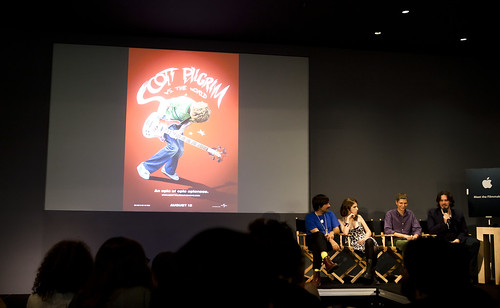
Anna Kendrick, etc. at the Apple SoHo store

The cast of “Scott Pilgrim vs. the World” made an appearance at the SoHo Apple store. I think I was the oldest person there, except for the older uncle who was pathetically trying to give kids money for their Scott Pilgrim cheap-ass memorabilia (even for $20-$40, no kid wanted to talk to him. I ended up giving him my lanyard because I felt sorry, and the sad fellow didn’t even say thank you).

Scott Pilgrim vs. The World at SoHo Apple Store, Michael Cera, An

Scott Pilgrim vs. The World at SoHo Apple Store, Michael Cera, Anna Kendrick, Jason Schwartzman, Edgar Wright

Kendrick plays such a difficult, uptight character in “Up in the Air”, which wasn’t a favorite of mine to begin with, that you forget that behind all those acting chops is an old fashioned hottie.

Scott Pilgrim cast at SoHo Apple Store

I would’ve gone just to see Edgar Wright talk, though. Shaun of the Dead and Hot Fuzz were pretty much brilliant. Without his name behind the helm of “Scott Pilgrim”, I would’ve dismissed it as another cute-but-not-as-good-as-Superbad-Michael-Cera-teen-comedy. Cera was funny, but the awkward-kid-schtick only goes so far, it was a lot more interesting to hear Wright talk about trying to emulate Hong Kong movies.

Kill Deathhacking

Paul Carr takes on the recent spawn of Methuselah-creators (TechCrunch):

So, please God, let’s put an end to this deathhacking nonsense. Let’s flush the pills, stock up on recreational drugs, drive fast cars, work long hours and stay inspired by nature’s crippling deadline to achieve greater and greater things in our fourscore years and ten.

BP Exec Would Eat Gulf Seafood – And I Had Yet Another Simpsons Flashback

From AFP:

BP’s chief operating officer [Doug Suttles] sought to give the southern US fishing industry a much-need boost Sunday, saying he’d “absolutely” eat Gulf of Mexico seafood after the massive oil spill devastated the region.

Suttles said: “There’s been a tremendous amount of testing done…I have a lot of confidence in those agencies and I trust their recommendations and I would eat their food — the seafood out of the Gulf, and I would feed it to my family.”

Bravo for Suttles at least making a non-wishy-washy statement, and for the Gulf possibly recovering enough for him to consider putting his family on the line. But did anyone over the age of 25 who watched “The Simpsons” not immediately think of this classic second-season episode?

How De Beers Diamonds Won over the Japanese…and everyone else

Thanks to Kevin Kelly’s list of the 100 Best Magazine Articles Ever, I came across this 1982 Atlantic article, “Have You Ever Tried to Sell A Diamond?” by Edward Jay Epstein.

Most of the controversy today attached to De Beers seems to be its alleged financial role in propping up African strife. Hence the term, conflict, or “blood diamonds“. De Beers supported reforms for conflict-free diamonds, though that didn’t stop Leo DiCaprio’s “Blood Diamond” from being made.

But Epstein’s article was written in 1982, before much of the African conflict that led to diamond-for-arms selling, and so the ~10,000 word piece is all about De Beers’ unparalleled ability to drive consumer demand for diamonds, a scheme that – minus the death and suffering – is as unsettling as the idea of inadvertently propping up Third World conflicts.

During the “Blood Diamond” movie uproar, the NYT’s Donald McNeil Jr. wrote that “creating new markets is the genius of DeBeers. Getting African-American men to wear bling works for them as well as their 1950’s campaigns to get Japanese brides to demand solitaires.” The creation of the latter market makes up one of the most interesting sections in Epstein’s 1982 article, as he describes how De Beers turned post-war Japan into the second biggest market for diamonds.

Until 1959, Epstein writes, Japan hadn’t even allowed for diamonds to be legally imported. In 1967, when De Beer’s began its campaign, only 5 percent of Japanese brides received diamond rings. In 14 years, Epstein writes, that percentage rose to 60 percent.

Their strategy? Good ol’ Euro/Western-envy:

Until the mid-1960s, Japanese parents arranged marriages for their children through trusted intermediaries. The ceremony was consummated, according to Shinto law, by the bride and groom drinking rice wine from the same wooden bowl. There was no tradition of romance, courtship, seduction, or prenuptial love in Japan; and none that required the gift of a diamond engagement ring. Even the fact that millions of American soldiers had been assigned to military duty in Japan for a decade had not created any substantial Japanese interest in giving diamonds as a token of love.

J. Walter Thompson began its campaign by suggesting that diamonds were a visible sign of modern Western values. It created a series of color advertisements in Japanese magazines showing beautiful women displaying their diamond rings. All the women had Western facial features and wore European clothes. Moreover, the women in most of the advertisements were involved in some activity — such as bicycling, camping, yachting, ocean swimming, or mountain climbing — that defied Japanese traditions. In the background, there usually stood a Japanese man, also attired in fashionable European clothes. In addition, almost all of the automobiles, sporting equipment, and other artifacts in the picture were conspicuous foreign imports. The message was clear: diamonds represent a sharp break with the Oriental past and a sign of entry into modern life.

I had always thought that diamonds were the pinnacle of a frivolous consumerism: it’s a rock. And not even that practical when compared to other fashion accessories. But I would’ve chalked my attitude up to being a cheap bastard who, if I had the money, would blow it all on a fancy diamond just to show everyone that hey, I really do love my fiancee, and here’s the giant, extremely valuable ring to prove it.

But, according to Epstein, diamonds weren’t even all that rare or precious. From the time De Beers became big, to when Epstein’s article was written, the company has had to devise some amazing marketing campaigns to assure buyers that diamonds would always be valuable. The most well-known of these initiatives was the “Diamonds are forever” campaign, named by AdAge has the best slogan of the century and still used today.

As Epstein wryly notes, “diamonds can in fact be shattered, chipped, discolored, or incinerated to ash” but the mantra, besides affirming the permanence of the rock (and by association, the relationship in which it was given), pushed the idea that diamonds should not be resold.

And so anyone who tried to resell their diamonds, Epstein wrote, would find that in some cases, they would’ve gotten a better return on investment by stuffing money under their mattresses. In one notable experiment, a magazine bought £400 worth of diamonds. Nine years later, the highest price those diamonds fetched, when adjusting for inflation, was £167…a nearly 60% drop in value.

The magazine tried the experiment again, with a larger gem and in a one-year period. The gem’s resale value dropped 25 percent. When they tried reselling an even more expensive gem, purchased one week earlier, their loss was 62 percent (again, to repeat, in one week).

Even stealing diamonds was a terrible scheme; in one case, a thief got only $200 for diamonds insured at $50,000.

So with millions of carats entering the market each year, and with very few of existing diamonds being sold or destroyed, how did De Beers keep the price up? Just brilliant marketing. For older married women who needed to be reminded how much they were loved, there was the “eternity ring,” encrusted with as many as 25 small diamonds. Why small diamonds? Because De Beers needed to handle the influx of the smaller rocks coming from the Soviet Union, according to Epstein. The unintended consequence of De Beers convincing women that size didn’t matter was, amusingly enough, a setback to sales of large diamonds.

At the time Epstein’s article was published, De Beers was reportedly scrambling to buy up the world’s supply with diamonds as more sources were being found. Epstein concluded that the company and its “diamond invention” might “disintegrate and be remembered only as a historical curiosity.”

Clearly, since 1982 when Epstein published, this hasn’t happened. Despite being hit hard by the global recession, De Beers recently posted a 74 percent increase in year-to-year sales, with net earnings of $255 million (this graphic purports to show a relatively stable price for diamonds). The supply seems to be as strong as when Epstein wrote, with De Beers predicting that they’ll produce 40 million carats next year.

If we lowball the world’s annual output of diamonds at about 100 million carats per year, that means ~3 billion carats of diamonds have been produced since Epstein wrote, entering a marketing ecosystem in which it is taboo to destroy or resell diamonds. And, judging by the most cursory of Google searches, those old diamonds aren’t getting any more valuable.

I’ve only summed up a small part of Epstein’s article. It only gets better; read the entirety of it here. Also, The Atlantic’s Stuart Reid, in 2006, mentioned Epstein’s piece in a roundup of other Atlantic articles about diamonds and the trouble they’ve caused in Africa.

Visit Epstein’s homepage to read the book version of The Atlantic’s piece.

Samuel Mark, Bedbug Artist

This snapshot I took of a bedbug-adorned mattress on St. Mark’s St. has an artist: Samuel Mark, who has apparently done several bedbug-inspired pieces. He was profiled in a Wall Street Journal blog:

M: You scavenge materials on the street. Are you concerned they have bedbugs?

M: I actually look at pieces before I touch them. I know what bedbugs look like. I had bedbugs in Brooklyn and I was in a place where they were in the whole building. They congregate in different places and come out at certain times. The times of night I write on these things is the time they are out. I look at all the creases. If I see any evidence of bedbugs on the thing, I do not touch it. And I wear rubber gloves.

h/t EV Grieve

“Letting Go” – The New Yorker’s Atul Gawande, on giving up life to live

Trinity Church Cemetery

Trinity Church Cemetery

Dr. Atul Gawande’s latest New Yorker piece is described as another examination on on what’s behind the cost of health care, but it serves more as a lesson on how to both cope with the finality of death and to appreciate life.

It took me several times to get through it, and luckily I wore my sunglasses in the subway so I wouldn’t look like some snob getting teary-eyed over his iPad.

The opening (and ultimately, closing anecdote) is about an ill-fated patient of Dr. Gawande’s, a Sara Thomas Monopoli, who discovers she has incurable cancer 39 weeks into her first pregnancy. Dr. Gawande describes Monopoli’s long struggle to stay alive, with taking a series of experimental drugs with harsh side effects; at one point, she hides the fact that she’s lost feeling in her hands and had double vision for two months, for fear her treatment would be stopped.

Gawande’s sprawling piece ends up being kind of a travelogue of his journey of accepting death for his patients. He believes, as do most people, that hospice care is meant to hasten death, even though at least one survey of terminal cancer patients found that those who elected for intensive care had similar survived no longer than those who entered hospice care.

As Gawande puts it:

Curiously, hospice care seemed to extend survival for some patients; those with pancreatic cancer gained an average of three weeks, those with lung cancer gained six weeks, and those with congestive heart failure gained three months. The lesson seems almost Zen: you live longer only when you stop trying to live longer.

Gawande relates this to the current health care crisis by pointing out a 2004 Aetna study in which policyholders expected to die within a year could choose hospice services and have all the other treatments. The hospice care was so appealing, apparently, that these patients spent far less time in hospitals and ICUs, even though they didn’t have to give up any options. Costs fell by nearly 25%

The benefits of accepting fate are not just monetary. Gawande writes that by many objective metrics, patients who seriously discussed end-of-life care ended up suffering less:

Two-thirds of the terminal-cancer patients in the Coping with Cancer study reported having had no discussion with their doctors about their goals for end-of-life care, despite being, on average, just four months from death. But the third who did were far less likely to undergo cardiopulmonary resuscitation or be put on a ventilator or end up in an intensive-care unit. Two-thirds enrolled in hospice. These patients suffered less, were physically more capable, and were better able, for a longer period, to interact with others. Moreover, six months after the patients died their family members were much less likely to experience persistent major depression.

In other words, people who had substantive discussions with their doctor about their end-of-life preferences were far more likely to die at peace and in control of their situation, and to spare their family anguish.

I can’t think of many other journalists who I respect more than Dr. Gawande. Besides having incredible eloquence as a writer, he’s a respected professional in the field he covers. His book “Complications,” nearly made me quit journalism to try med school – it was that fascinating of a look into how terrifying, yet intellectually challenging, it would be to be an ER surgeon – until I realized it would be a long, uphill slog for someone who never took a college level biology class.

Atul Gawande

Atul Gawande

Gawande has had at least two other notable pieces. One, related to the subject of “Complications,” was how a checklist consisting of steps as simple as reminding doctors to wash their hands was saving a staggering number of patients from post-surgical infections. And the second, about how one town in Texas managed to have the highest, by far, health care costs per capita. The article reportedly caught President Obama’s eye during the health care overhaul.

Both are instructive essays on the complexity of health care. “Letting Go” is less so, perhaps because there are no cost-benefit studies that would convince either death-panel-fearing-Tea-partiers or an insurance-company-demonizers that the health care system would ever be right to compel a patient to give up treatment.

But as a collection of tragic anecdotes, “Letting Go” really shook me and at least made me remember to appreciate what’s good in life. Maybe that’s Gawande’s ulterior strategy all along, to convince the reader to place enjoying life over prolonging it, and by doing so, maybe, get both.

Another New Yorker piece (h/t/ longform.org), written in 2001 by Gary Greenberg, also examines the moving line between life and death, and in particular, how where the line is drawn has been influenced by the demand for organs. With the concept of “brain death”, organs can be retrieved in a more viable state, as opposed to waiting until the heart stops beating. But doctors and ethicists (I assume today, as well as in 2001) are still arguing about the different kinds of brain death, and even those who accept it, they still have to train themselves to think of a warm, breathing body as “dead”:

“It took us years to get the public to understand what brain death was,” [Howard M. Nathan, who heads an organ-procurement group] said. “We had to train people in how to talk about it. Not that they’re brain dead, but they’re dead: ‘What you see is the machine artificially keeping the body alive . . .’ “ He stopped and pointed to my notebook. “No, don’t even use that. Say ‘keeping the organs functioning.’ “

And if you’ve got even more time to spend reading life-or-death longform pieces, I’ll pitch this 13,000-word Pulitzer-winning piece by my ProPublica colleague, Sheri Fink. The subject is how doctors at a New Orleans hospital may have been to quick to euthanize a group of patients while desperately waiting for rescue after Katrina.

The overarching theme, as it is in the New Yorker articles mentioned here, is what makes a life worth living/saving, and can doctors make that decision when patients can’t?

Gawande:

“Is she dying?” one of the sisters asked me. I didn’t know how to answer the question. I wasn’t even sure what the word “dying” meant anymore. In the past few decades, medical science has rendered obsolete centuries of experience, tradition, and language about our mortality, and created a new difficulty for mankind: how to die.

Greenberg:

He wanted to show that the higher-brain rationale, which holds that living without consciousness is not really living—and which the President’s commission rejected because it raised questions about quality of life which science can never settle—was the sub-rosa justification for deciding to call a brain-dead person dead. He wanted to make it clear that these doctors were not making a straightforward medical judgment but, rather, a moral judgment that people like Matthew were so devastated that they had lost their claim on existence.

Fink:

According to Memorial workers on the second floor, about a dozen patients who were designated as “3’s” [a triage category for patients thought to be close to death] remained in the lobby by the A.T.M. Other Memorial patients were being evacuated with help from volunteers and medical staff, including Bryant King. Around noon, King told me, he saw Anna Pou holding a handful of syringes and telling a patient near the A.T.M., “I’m going to give you something to make you feel better.” King remembered an earlier conversation with a colleague who, after speaking with Mulderick and Pou, asked him what he thought of hastening patients’ deaths. That was not a doctor’s job, he replied. Patients were hot and uncomfortable, and a few might be terminally ill, but he didn’t think they were in the kind of pain that calls for sedation, let alone mercy killing. When he saw Pou with the syringes, he assumed she was doing just that and said to anyone within earshot: “I’m getting out of here. This is crazy!” King grabbed his bag and stormed downstairs to get on a boat.

Xi’an Famous Foods, Savory Cumin Lamb Noodles

The best $6.00 meal ever: Savory Cumin Lamb Noodles, or just “D1″. Xi’an Famous Foods just opened in the East Village to much fanfare. I guess they have a few spots throughout the city and have been featured on the Food Network and Anthony Bourdain’s show.

I’m no noodle expert, but their hand pulled liang pi noodles are the best noodles in the entire world, and conveniently located in the East Village on St. Marks. Well, they must be pretty good if they’re the number 2 result for liang pi in Google.

Here’s a picture of the tiny interior. Go to the Flickr full size version to zoom into the actual menu items and prices.

Xi'an Famous Foods

Khmer Rouge’s Duch’s Duck

Inmate photographs from www.tuolsleng.com

Inmate photographs from www.tuolsleng.com


Kaing Guek Eav, also known as Duch (or Deuch), was the first of Khmer Rouge officials to be put on trial for crimes of humanity. The Khmer Rouge is estimated to have killed as many as 1.7 million people from 1975-1979. The former schoolteacher was charged with overseeing Tuol Sleng prison, where at least 14,000 people were tortured, with such heinous methods as “live autopsies” or starved to death, according to Duch’s confession:

From the Guardian:

Mey recounts the tortures used to extract false confessions from prisoners and force them into implicating others as CIA spies. He was beaten with bamboo rods, forced to eat faeces, given electric shocks to his ears, and had his toenails ripped out with pliers. Others were waterboarded, hung upside down, and had their hands crushed in clamps. Children were thrown from third-storey balconies to their deaths. Prisoners were presumed guilty, effectively already dead, Duch has said.

Notes found in the Tuol Sleng prison he oversaw:

The notes record the results of 11 “experiments” with 17 prisoners, living and dead. They begin:”1. A 17-year-old girl, with her throat cut and stomach slashed, put in water from 7.55 p.m. until 9.20 a.m., when the body begins to float slowly to the top, which it reaches by 11.00 a.m. “2. A 17-year-old-girl bashed to death, then put in water as before, for the same period, but the body rises to the top at 1.17 p.m.”Similar details were recorded for “a big woman, stabbed in the throat, her stomach slashed and removed,” and “a young male bashed to death,” then “four young girls stabbed in the throat,” and “a young girl, still alive, hands tied, placed in water..”If Deuch didn’t write these lines, he knows who did. Someone should ask him.

Duch

Duch (Reuters)

Duch, now 67, was sentenced to 30 years in prison, only 19 of which he has to still serve. He could still be alive at the end of his prison term, which isn’t too bad of a situation to be in, as one victim bitterly complained to the New York Times: “His prison is comfortable, with air-conditioning, food three times a day, fans and everything,” he said. “I sat on the floor with filth and excrement all around.”

Not satisfied with that lenient sentence, Duch and his legal team are reportedly seeking an appeal. Earlier in the process, Duch’s French and Cambodian lawyers argued about whether to seek leniency or acquittal. It’s hard to decide who had the more execrable argument: Duch’s Cambodian lawyer, Kar Savuth, who argued that Duch should be freed because Duch wasn’t the only mass murderer and Tuol Sleng wasn’t even the worst of the prisons: “It would be better not to try anyone than to try some and leave others at large.”

Or the French lawyer, Francois Roux, ( later fired by Duch), who combined both the Nuremberg defense and Jesus’s ‘Let he who is without sin cast the first stone” dictum:

From the NYT:

Duch’s second lawyer, François Roux, said Duch was part of a hierarchy of terror in which all the actors were in effect victims as well as perpetrators.

“It was because of the terror that every link in the chain of command acted zealously to please superiors,” Roux said.

Taking his argument of moral equivalence a step further, Mr. Roux said that just as Duch had dehumanized his victims, his accusers and victims were guilty of dehumanizing him.

“Duch remains a human being,” he said, addressing prosecutors. “Maybe there are certain points at which he has a bit of trouble admitting certain things. But maybe you as well have trouble admitting certain things.”

Is there a Guinness World Record in a man’s ability to dodge responsibility? It makes you wish international standards and decorum could be set aside, as in a Jerry Bruckheimer movie or South Park episode, so that we could hear the judge respond justly and firmly with a simple, Fuck. You.